
Leading with Trust

Conflict gets a bad rap. Most people tend to view conflict as a bad thing, automatically assuming it has to be an adversarial win or lose situation. The reality is that conflict is inevitable in relationships and it isn’t inherently a negative thing. It depends if you choose to manage the conflict or let the conflict manage you.

I’m a fan of the Thomas Kilmann model of conflict management because of its dispassionate approach to the topic and the practical strategies it offers for its followers. Kilmann defines conflict as any situation where your concerns or desires differ from those of another person. That can be as simple as deciding where to go for dinner with your spouse to something as complex as brokering the details of a huge corporate merger.
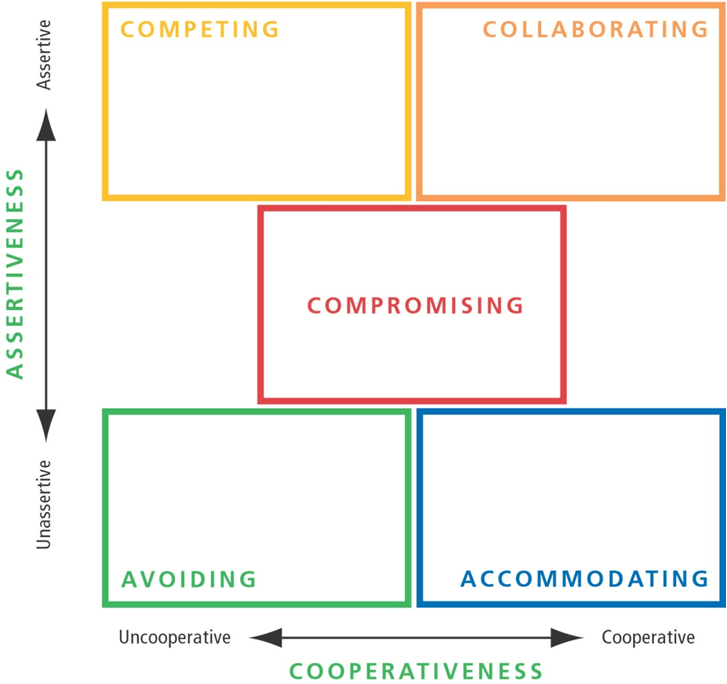
According to Kilmann’s model there are five basic modes of handling conflict that result from the amount of assertiveness and cooperation you employ. Each of us tend to have a natural, default mode we use when faced with conflict, but that particular mode isn’t always appropriate for every situation. The key to effectively managing conflict is to understand which mode is most appropriate for the situation given the outcomes you’re trying to achieve. Here’s a quick snapshot of the five modes of managing conflict:

Avoiding – Taking an unassertive and uncooperative approach to conflict defines the Avoiding mode. Sometimes avoiding conflict is the best move. Perhaps the issue isn’t important enough to address or you need to allow some time to pass to diffuse tensions. But of course avoiding conflict can also be harmful because issues may fester and become more contentious or decisions may be made by default without your input or influence.

Competing – High on assertiveness and low on cooperativeness, the competing mode is appropriate when you need to protect yourself, stand up for important principles, or make quick decisions. Overuse of the competing style tends to result in people around you feeling “bulldozed,” defeated, and un-empowered.

Collaborating – The collaborating mode is the highest use of assertiveness and cooperation and is appropriate when your focus is on merging the perspectives of the parties, integrating solutions, and building relationships. Overusing the collaboration mode can lead to inefficiency,  wasting time, and too much diffusion of responsibility (because if everyone is responsible, then really no one is responsible).

Compromising – Many times people think compromising should be the goal of resolving conflict. I give up something, you give up something, and we agree to settle somewhere in the middle…hogwash! There are certainly times when compromise is the best route, such as when the issue in dispute is only moderately important or you just need a temporary solution. But if you overuse the compromising mode, you can neglect to see the big picture and create a climate of cynicism and low trust because you’re always giving in rather than taking a stand.

Accommodating – This mode is high on cooperativeness and low on assertiveness which is appropriate for situations where you need to show reasonableness, keep the peace, or maintain perspective. If you overuse the accommodating mode, you can find yourself being taken advantage of, having your influence limited, and feeling resentful because you’re always the one making concessions to resolve conflict.

Conflict is a natural part of any relationship, and if managed effectively, can lead to deeper and stronger bonds of trust and commitment. The key is to diagnose the situation, determine your preferred outcomes, and use the mode most appropriate to help you achieve your goals.

Want to Build Trust? Get Naked!

Establishing trusted relationships is a critical imperative for leadership success today, and a key way to develop trust with those you lead is by being vulnerable. I’m not talking about getting on the proverbial therapist’s couch and telling your direct reports all of your deep, inner secrets. I’m talking about disclosing appropriate and relevant amounts of information about yourself over the course of time as relationships grow and develop.

In his book, Getting Naked, author Patrick Lencioni discusses three fears that keep us from being vulnerable…from “getting naked.” Lencioni discusses these fears in the context of sabotaging client relationships, but the lessons are equally relevant for leaders in regards to developing trust with their followers. Leaders sabotage trust by giving in to the following fears:

  • The fear of losing followership (“business” in the context of Lencioni’s parable about client relationships) – The business of a leader is influencing others to achieve their personal goals and those of the organization. Sometimes leaders fear being vulnerable because it could be perceived as a sign of weakness, or evidence that their leadership isn’t needed. Leaders can conquer this fear by being “other-focused” rather than self-focused and remembering that their top priority is to help others succeed. When your followers believe you have their best interests in mind, they will trust you and give you the discretionary energy and commitment that is essential for organizational success.
  • The fear of being embarrassed – Many leaders are afraid they will be embarrassed by not having all the right answers or being proven wrong in public. To prevent embarrassment, leaders play their cards close to the vest, don’t share information with others, and don’t allow participation in decision-making. Creating a culture where mistakes are celebrated as learning opportunities, risk taking is encouraged, and stupid or obvious questions encouraged will help allay this fear and lead to higher levels of trust in leaders’ relationships.
  • The fear of feeling inferior – This fear is rooted in the leader’s ego. Ken Blanchard likes to say that EGO stands for “edging good out.” Leaders do this by focusing on their reputation and social standing and pushing all other interests aside. These kinds of leaders often derive their self-worth from the successes they achieve and the applause of adoring fans. Trusted leaders overcome this fear by cultivating an attitude of humility. Humility doesn’t mean that you think less of yourself. It means you think about yourself less. You build trust by keeping the focus on the goals of the team and the needs of your followers and not worrying about who gets the credit for success.

The bottom line effect of getting naked with your followers is that you’ll develop trusted relationships that will fuel the success of your team and organization.

“There can be no vulnerability without risk; there can be no community without vulnerability; there can be no peace, and ultimately no life, without community.”
M. Scott Peck

Are Delayed Apologies More Effective in Rebuilding Trust?

Alben Barkley, Vice President to Harry Truman, said about political apologies, “If you have to eat crow, eat it while it’s hot.” Most of us would agree that when it comes to making an apology, it’s better to act quickly, say your mea-culpa, do what you can to repair the damage, and then put the issue behind you.

However, when it comes to rebuilding trust and confidence with those you’ve offended, the timing of your apology could make all the difference between restoration and healing or just adding insult to injury.

In his newest book, Wait – The Art and Science of Delay, author Frank Partnoy gives several examples from academic research and popular culture that illustrate the importance of discerning the right time to make an apology. It’s not a question of if you need to apologize, but when.

For example, if you bump into a person while standing in line, or spill a drink on someone at a cocktail party, it’s expected and appropriate to apologize immediately. The offense is accidental and impersonal, and to not apologize immediately would be rude and disrespectful. Yet when it comes to more personal and complex situations, an immediate apology may come across as lacking sincerity, thoughtfulness, or care.

Partnoy points out that there are two good reasons to delay your apology. The first is that a snap apology may prevent the offended party from fully expressing how he or she feels about the situation, particularly if it’s a serious, personal transgression. The person wronged needs time to process what happened, understand what the intentions may have been of the offender, and what the ramifications are for their relationship.

The second reason to consider delaying your apology is that letting some time elapse allows additional information or feelings to bubble to the surface. Time and space allows the offended party to fully process their thoughts and emotions, and allows for ongoing discussion that can provide helpful context for why things happened the way they did. Having a more complete understanding of the background behind a transgression can allow the offended to progress to an emotionally open place where they can fully receive the apology.

Research by Frantz and Bennigson concludes that victims feel more satisfied when apologies are delayed because it gives them a chance to express themselves and feel that their concerns have been heard. Their studies suggest that the relationship between timing and the effectiveness of apologies follows a natural distribution curve: effectiveness is low to begin with, rises as time elapses, and then reaches a point where too much elapsed time reduces the effectiveness of the apology.

So when is the right time to apologize? Well, like most complicated issues in life, the answer is “it depends.” Partnoy suggests that the next time you offend a close friend or family member, you might want to think about how they will respond to an immediate apology versus one that is delayed a bit. Will the apology be more effective if it’s delivered today or tomorrow? Tomorrow or next week? If letting some time pass will give the offended party time to understand the full context of the situation and express their feelings, then chances are a delayed apology will be more effective than an immediate one.

If you’ve really screwed up, you’ll probably have to apologize several times throughout the healing process. It’s important to apologize, express remorse, and then listen. Let the offended express their feelings, observe and reorient yourself to where you stand in the healing process, and then move forward with picking up the pieces.

Sometimes when you eat crow, it’s better not to eat it hot or cold. Sometimes it’s better served warm.

Hey, Leaders! Quit Talking & Start Listening – 4 Tips to Build Trust

“To answer before listening – that is folly and shame.”
Proverbs 18:13

It’s easy for leaders to fall into the trap of thinking they need to have the answer to every problem or situation that arises. After all, that’s in a leader’s job description, right? Solve problems, make decisions, have answers…that’s what we do! Why listen to others when you already know everything?

Good leaders know they don’t have all the answers. They spend time listening to the ideas, feedback, and thoughts of their people, and they incorporate that information into the decisions and plans they make. When a person feels listened to, it builds trust, loyalty, and commitment in the relationship. Here are some tips for building trust by improving the way you listen in conversations:

  • Don’t interrupt – It’s rude and disrespectful to the person you’re speaking with and it conveys the attitude, whether you mean it or not, that what you have to say is more important than what he or she is saying.
  • Make sure you understand – Ask clarifying questions and paraphrase to ensure that you understand what the person is trying to communicate. Generous and empathetic listening is a key part of Habit #5 – Seek first to understand, then to be understood – of Covey’s famous Seven Habits of Highly Effective People.
  • Learn each person’s story – The successes, failures, joys, and sorrows that we experience in life weave together to form our “story.” Our story influences the way we relate to others, and when a leader takes time to understand the stories of his followers, he has a much better perspective and understanding of  their motivations. Chick-fil-a uses an excellent video in their training programs that serves as a powerful reminder of this truth.
  • Stay in the moment – It’s easy to be distracted in conversations. You’re thinking about the next meeting you have to run to, the pressing deadline you’re up against, or even what you need to pick up at the grocery store on the way home from work! Important things all, but they distract you from truly being present and fully invested in the conversation. Take notes and practice active listening to stay engaged.

My grandpa was fond of saying “The Lord gave you two ears and one mouth. Use them in that proportion.” Leaders can take a step forward in building trust with those they lead by speaking less and listening more. You might be surprised at what you learn!

Are You a Good Boss or a Bad Boss? 8 Ways to Tell

“Are you a good boss or a bad boss?” That question reminds me of the scene from the Wizard of Oz when Glinda, the Good Witch of the North, first encounters Dorothy in Munchkinland. Glinda asks Dorothy “Are you a good witch, or a bad witch?” Dorothy replies that she’s not a witch at all, and besides, witches are old and ugly. After being informed that the beautiful, young Glinda is a witch, Dorothy says “You are! I beg your pardon! But I’ve never heard of a beautiful witch before.” Glinda responds, “Only bad witches are ugly.”

I think only bad bosses are ugly.

How do you know if you’re a good boss or a bad boss? Just over a year ago, Google’s People Operations group unveiled the results of their two-year study into what separates bad bosses from good bosses in their own company. They performed extensive data analysis on performance reviews, feedback surveys, and nominations for top-manager awards. What they came up with was 8 behaviors that distinguished the best bosses at Google. How do you stack up against this list?

1. Be a good coach

    • Provide specific, constructive feedback, balancing the negative and the positive.
    • Have regular one-on-ones, presenting solutions to problems tailored to your employees’ specific strengths

2. Empower your team and don’t micromanage

    • Balance giving freedom to your employees, while still being available for advice. Make “stretch” assignments to help the team tackle big problems.

3. Express interest in team members’ success and personal well-being

    • Get to know your employees as people, with lives outside of work.
    • Make new members of your team feel welcome and help ease their transition.

4. Don’t be a sissy: Be productive and results-oriented

    • Focus on what employees want the team to achieve and how they can help achieve it.
    • Help the team prioritize work and use seniority to remove roadblocks.

5. Be a good communicator and listen to your team

    • Communication is two-way: you both listen and share information.
    • Hold all-hands meetings and be straightforward about the messages and goals of the team. Help the team connect the dots.
    • Encourage open dialogue and listen to the issues and concerns of your employees.

6. Help your employees with career development

7. Have a clear vision and strategy for the team

    • Even in the midst of turmoil, keep the team focused on goals and strategy
    • Involve the team in setting and evolving the team’s vision and making progress toward it.

8. Have key technical skills so you can help advise the team

    • Roll up your sleeves and conduct work side by side with the team, when needed.
    • Understand the specific challenges of the work.

Kind of a no-brainer list, huh? It reinforces the idea that leaders can make tremendous strides by simply following the basics: Be interested in your folks, help them achieve their goals, provide the resources and support they need and get out of their way, communicate and share information, and have a vision for where the team needs to go.

Hopefully you’re a good boss and these behaviors are already part of your repertoire. If they aren’t, don’t worry. They’re all things that are very much under your control and you can incorporate them into your leadership practices. After all, you don’t want to be a bad boss. Bad bosses are ugly.

Three Tips to Build Trust by Closing the Knowing-Doing Gap

Most leaders don’t show up to work saying to themselves, “I think I’ll erode trust with my people today!” yet that’s often what happens despite their best intentions. It’s too easy to walk through the office doors, turn on the auto-pilot switch, and fly through the day without putting much intentional and deliberate thought into our choices and decisions and how those either build or erode trust with others.

It’s not that leaders DON’T KNOW what to do (although there certainly are times when that is the case), it’s that we don’t put into practice what we DO KNOW. It’s the classic “knowing-doing gap.” We know what to do, but we don’t do it. Why is that? The answer is complex, multi-layered, and certainly worth exploring, but perhaps even more important is answering the question “What do we do about it?”

The reason it’s so important to answer this question, is that when it comes to building trust, your actions speak louder than words. You can have the best intentions in the world to build positive, high-trust relationships with your people, but if those intentions aren’t translated into tangible, practical, trust-building behaviors in the workplace, your relationships will never reach their full potential.

Here are three tips for leaders that can help close the knowing-doing gap:

1. Identify the gap — Before you can close the knowing-doing gap, you need to know where you’re starting from and where you want to go. Which of the four elements of trust is your strong suit and which is your biggest area for growth? Within your growth area, what are the specific behaviors you need to focus on that will help you build trust, and how will you know when you’ve made measurable progress in that area?

2. Create a roadmap for improvement — Once you’ve identified the specific trust-building behaviors you want to focus on, create an action plan that will help you achieve your goal. I’m a fan of quality over quantity, so I would suggest focusing on one or two key behaviors and putting intentional and focused effort in improving your use of those behaviors, rather than trying to do too much at one time. Leaders are hard-wired to make an impact and we’re often our own worst enemy in trying to do too much, too fast. Building trust can seem like an ominous task, especially if you’re starting from a point of very low or non-existent trust, yet it can be accomplished over time through the use of very specific behaviors.

3. Make course corrections — Ask for feedback from those you’re trying to build trust with, listen to it, and make course corrections to your strategy as appropriate. Asking for feedback is a trust-building behavior in and of itself, and when your people see you taking their feedback seriously and changing your behavior as a result, your “trust stock” rises immeasurably in their eyes.

If you’re thinking about embarking on this journey of closing the knowing-doing gap in order to build trust, I would offer you one warning and one encouragement. The warning: Don’t do it unless you’re going to follow-through! Announcing that you’re going to make an effort to improve in this area, and then either not following through or only doing so half-heartedly, will do more to erode trust than not doing anything at all.

The encouragement: You can do it! Trust is built by using very specific behaviors that all of us are capable of doing. If you identify where you need to improve, map out a plan to get better, and make course corrections to stay on track, you’ll develop higher-trust relationships that will fuel your success and that of your people.

Father’s Day Special: Five Leadership Lessons From Being a Dad

Being a dad has been, and continues to be, one of the greatest joys of my life. I’ve experienced tremendous highs, suffered through some lows, doubted myself, learned much, and have been stretched to grow in ways I couldn’t have imagined when I first started this journey twenty years ago. The same could be said for my journey as a leader!

As I reflect on the lessons that have taught me to be a better father, I realize that many of the same principles apply to being a trusted and successful leader. Here are five leadership lessons I’ve learned from being a dad:

  1. There’s no substitute for time — I’ve learned that “quality” time is just a convenient rationalization to justify our busyness and to ease our guilt from not spending “quantity” time with our kids. The “quality” happens in those unexpected moments during the “quantity.” Being a leader requires spending large amounts of time with your people and not isolating yourself in your own little world. Devote yourself to investing in the growth and development of your people and you’ll reap the rewards.
  2. Set clear expectations — Part of being a good dad is setting clear expectations for his kids. They should know what’s expected in terms of their behavior and attitudes, and what the consequences will be (either positive or negative) for meeting or not meeting those expectations. Your people at work need the same clear expectations regarding their performance. They need clear targets with identifiable rewards or consequences. It’s not fair to judge your people (or kids) for their actions if they weren’t clear on the goal in the first place.
  3. Be the example — Being a dad means setting the right example for his kids and the same is true in being a leader. Your attitudes, the tone of voice you use in speaking to others, your work ethic, and the way you treat people are just a few of the ways you will influence your people. Just as a child will observe and often imitate every move of his dad, your people are always taking their cue from the actions of their leader. Make sure you’re leading well!
  4. Have fun — It’s easy to get bogged down in all the stress and anxiety that comes with being a dad, but I’ve learned to have fun and enjoy the journey as much as possible. Leaders need to remember to take work seriously, but not take themselves too seriously. Laugh at yourself, keep the mood light, and don’t be afraid to have fun with your staff. When the stressful times come, your people will be more willing to put in the extra effort that’s necessary.
  5. Validate them — One of the primary roles of a father is to validate his children. A father’s approval imparts a tremendous amount of psychological and emotional confidence in a child that empowers him to grow in confidence and faith in his own abilities. Your staff needs your approval as well. When your people know that you accept them, desire the best for them, and will do whatever you can to help them succeed, you will have their loyalty and commitment in following your lead.

Leading and managing adults at work is obviously not the same as parenting children, although some days it can certainly feel that way! However, the principles one uses to be a successful father (or mother) can be equally beneficial for success as a leader. Just like being a father, the key is being consistent in your approach and having the best interests of your people in mind.

By no means are these five principles a definitive list. I’m curious to know what lessons you’ve learned from being a parent that apply to leadership. Feel free to share your thoughts by leaving a comment. Happy Father’s Day!

Deception Destroys Trust – 10 Questions to Ask To Keep From Being Duped

Contrary to popular belief, trust is not as fragile as we make it out to be. Trust can be one of the strongest forces in the world, binding people, institutions, and nations together in the midst of incredible adversity. Trust can be amazingly resilient, and when broken, can be restored over time through diligent and intentional behavior.

Research findings from Wharton have shown that “trust harmed by untrustworthy behavior can be effectively restored when individuals observe a consistent series of trustworthy actions,” and that making promises to change behavior can help speed up the process. However, the study also found that  “Trust harmed by the same untrustworthy actions and deception, never fully recovers – even when deceived participants receive a promise, an apology, and observe a consistent series of trustworthy actions.”

In order to build trust you have to first extend trust. Extending trust to others requires wisdom and discernment, and the amount of trust extended grows over time as you observe repeated, consistent, and reliable behaviors that cause you to make yourself more vulnerable to another person without fear of being taken advantage of or being harmed. There will inevitably be instances in relationships where one party breaks trust and disappoints another, either intentionally or unintentionally, and those occasions are usually repairable. Yet when intentional deception is involved, it strikes at the heart of the very integrity and character of the deceiver.

Dr. Bill Knaus suggests that you can protect yourself from harmful deceptions through enlightened skepticism and confident composure. Enlightened skepticism is a way to discern the facts of a situation through asking questions that force you to think critically. It helps you learn who to trust and to what degree so that you minimize the risk of deception in the first place.

Confident composure is a belief that you can directly command only yourself and you choose to do so. When you are in charge of yourself, you believe you can better influence the controllable events that take place around you. It’s a self-empowering approach to acting confident and composed that allows you to come across as authentic and resolute in your convictions and actions.

Dr. Knaus says that “You are vulnerable to lies and deceptions when you don’t know the facts, the situation is fuzzy, or you want to believe” and he offers the following ten enlightened skepticism questions to gain clarity:

  1. What do I know about the speaker’s truthfulness?
  2. Is the statement consistent with reality?
  3. Can I verify the statement?
  4. What do I gain by accepting and acting on the statement?
  5. What do I lose by accepting and acting on the statement?
  6. What does the speaker gain if I bought into the statement?
  7. What is exaggerated or downplayed in the statement?
  8. Does the idea seem too good to be true?
  9. Would I advise my best friend to accept the statement without a question of doubt?
  10. What doesn’t compute? (Is something being said too emphatically or in some strange way?)

Trust is an active and vibrant dynamic in relationships, not a passive condition that “just happens” over time. Part of developing a high trust relationship is being wise about who and what you trust. Not all people or situations are deserving of your trust, and approaching these situations with confident composure and enlightened skepticism is a proactive way to help prevent you from being deceived in the first place.

“Situational Crying” – An Effective Way to Build Trust?

Sheryl Sandberg, Chief Operating Officer of Facebook, made news recently when she admitted to crying at work during a speech at Harvard Business School. Sandberg said,

I’ve cried at work.  I’ve told people I’ve cried at work. And it’s been reported in the press that ‘Sheryl Sandberg cried on Mark Zuckerberg’s shoulder’, which is not exactly what happened. I talk about my hopes and fears and ask people about theirs.  I try to be myself – honest about my strengths and weaknesses – and I encourage others to do the same. It is all professional and it is all personal, all at the very same time.

My colleague, Maria Capelli, sent me and several other colleagues a link to this article which prompted an interesting email discussion about the advantages and disadvantages of showing emotion in the workplace, especially from a leadership perspective.

Maria said that “Being vulnerable, not only as a leader but as a fellow co-worker, can help build trust.  Being real/authentic can help build credibility.  I am not saying we should all start crying at work – it’s situational. As long as it’s not disruptive or frequent, I think it’s perfectly healthy.  And besides, suppression of our emotions for long periods of time cannot be healthy for the mind, body and soul.”

Our colleague, Susan Fowler, co-author of our Situational Self Leadership training program and our soon-to-be-released program, Optimal Motivation, mentioned that the real “F” word in corporate America is “feelings,” and the interesting paradox leaders are faced with when regulating their emotions: Is not crying when you want to a form of self-regulation, or is crying and owning your emotion a form of self-regulated courage to be honest in the workplace?

I agree that a critical part of building trust is being vulnerable and authentic, and sometimes that involves showing emotion in the workplace, within reason of course. I think Susan brings up an interesting connection between self-regulation, managing emotions, and being emotionally intelligent. My experience is that people who are emotionally intelligent and good at self-regulation have the ability to express the appropriate emotions at the appropriate time. Those who are challenged in those areas seem to be the ones that go overboard which leads to being known as emotionally unstable and unpredictable. Being reliably consistent and predictable in your behavior is a key component of developing trust with others.

Emotional intelligence is a critical success factor for succeeding in today’s business world. A recent survey by CareerBuilder showed that hiring managers are increasingly looking for candidates with high EQ’s because they are more likely to stay calm under pressure, handle stress better, and approach workplace relationships and conflict with greater maturity and sense of perspective.

There’s no doubt that showing the proper amount of emotion, in the right place at the right time, can be a key to building trust. The key is for leaders to develop the emotional intelligence and maturity to properly discern when the timing is right and when it’s wrong. As my colleague Maria said, “it’s situational.”

Your Personality Is Not An Excuse For Bad Behavior

One of my pet peeves is people who use their personality as an excuse for their behavior. “I can’t help it, that’s just who I am” is the phrase that’s often uttered to rationalize or justify an action, position, or attitude. In some ways it’s almost the perfect defense to any argument, isn’t it? “You mean you want me to change who I am?” How can you ask someone to change the very essence of what makes them who they are?

There’s no doubt that our inborn temperament and  natural personality traits shape the way we perceive and react to our environment, however, we are in control of the way we choose to respond to situations. Part of being a successful and trusted leader is learning how to regulate your thoughts, emotions, and natural personality traits so that you can respond in a manner that is appropriate for the situation at hand. Using your personality as a crutch to stay in your emotional comfort zone will only limit your leadership potential and alienate those around you.

Your personality is not an excuse for…

Being rude to people — If you frequently find yourself saying “I’m just being honest and telling it like it is,” then you’re probably relying too much on your default nature of being direct and to the point. Those are great traits to possess, but they shouldn’t be used as an excuse for being harsh or inconsiderate with people.

Not giving feedback when feedback is due — It’s difficult for most people to deliver constructive criticism to others, but people often hide behind their personality traits as an excuse to not give feedback. Whether you’re introverted and shy and find it difficult to engage others, or an extroverted people-pleaser that can’t stand the idea of someone not liking you, you have to learn ways to give feedback. You owe it to yourself and others.

Avoiding or inciting conflict — Along the same lines as giving feedback, dealing with conflict is probably the most common area where we stay in our emotional comfort zone. This is especially dangerous for people who tend to fall on the edges of the spectrum in dealing with conflict – either avoiding it or gravitating to it. Whatever your natural style of dealing with conflict, it doesn’t mean that’s the only way to deal with it. Just as important as knowing your natural tendencies, it’s important to know how others tend to deal with conflict so that you can “speak the same language” when trying to resolve issues.

Blaming others — It’s easy for us to blame others for whatever shortcomings we may have in our life or career; it’s much harder to honestly examine ourselves and take responsibility for the choices we’ve made that have led us to where we are today. For example, if you have a personality need to always be right, and you demonstrate that by constantly arguing and debating with colleagues, you shouldn’t blame others when people stop including you in projects, meetings, or decisions. “They don’t want my opinion because they don’t respect me and don’t want to hear the truth”…no…they don’t want your opinion because you always think you’re right and it’s annoying!

Our personalities are what makes us the unique individuals we are, and the beauty of organizational life is that we’re able to take this diversity and blend it into a cohesive whole that’s more productive and powerful than the individual parts. Learning to be more aware of our own personalities and those of others, combined with a willingness to stretch out of our comfort zones and not always rely on our natural instincts, will help us lead more productive and satisfying lives at work.

If It’s Broken, Do You Fix It or Throw It Away?

When you have something that’s broken, do you fix it or throw it away? Many of the products we buy today, especially electronics, have become disposable commodities that are more cost-effective to replace than repair.

Unfortunately, this same attitude has transferred over to many other areas of lives, particularly relationships. If a relationship no longer works for us, we’re quick to throw it away and look for another one to replace it. In describing the generational attitude of her parents who recently celebrated their 35th anniversary, an acquaintance said “they are of a generation that when something broke, they fixed it instead of throwing it away.” She was specifically talking about their view on relationships, not possessions.

It got me thinking about the value we place on relationships at work. When a relationship needs repairing in the workplace, what’s your instinct? Do you try to fix it or just throw it away?

Relationships have an inherent value that goes beyond the surface-level, transactional nature of workplace interactions, and each exchange you have with a co-worker is an opportunity to enrich or degrade the relationship. My friend Jon Mertz recently wrote a blog article about the importance of understanding the type of “wake” you leave behind in your interactions with others. People interested in building high-trust relationships understand the importance of leaving behind a wake of integrity, sincerity, and authenticity in their associations with colleagues.

When it comes to repairing a broken relationship, if it’s important to you, you’ll find a way. If not, you’ll find an excuse.

Granted, it takes two people to be in relationship, and if one party isn’t willing to fix what’s broken, it may not be possible to fully repair it. However, the only thing that each of us ultimately controls is our own actions. Leading with trust means reaching for the greater good that exists within us, placing a premium value on our relationships, and making the effort to repair what’s broken rather than throwing it away. Relationships aren’t easily replaced.

The Incredible “Sulk” – Four Ways to Overcome Envy in the Workplace

The Incredible Hulk, one of the Marvel Comics superheros featured in the recently released film The Avengers, is a raging beast capable of great fury and destruction. Whenever the mild-mannered Dr. Bruce Banner experiences certain negative emotions like fear, anger, or terror, he succumbs to those feelings and transforms into the Hulk, leaving a wake of destruction in his path.

Envy has the same potential for damage in the workplace by transforming you into The Incredible “Sulk” – someone with a sullen, silent, inwardly focused negative self energy that wreaks havoc on yourself and others. Envy is a feeling of discontent or covetousness a person feels in regards to another person’s success, advantages, or possessions, and causes you to sulk, feel sorry for yourself, and make you downright miserable. If left unchecked, envy creates resentment toward others, leads to fractured relationships, and causes low morale and a loss of productivity in a team environment.

I coach others, and have personally used, the following strategies to overcome envy in the workplace:

  • Don’t play the comparison game—The number one way to make yourself miserable with envy is to compare yourself to other people. There will always be someone who appears to have it better than you, whether it’s that recent promotion, title, new office, or cool new project at work. In addition to not rightfully acknowledging the successes or achievements of others, when you compare yourself to others you’re actually denying or discounting all the wonderful gifts, talents, and abilities you bring to the table. Focus on “blooming where you’re planted” and don’t waste energy by obsessing about what other people are doing.
  • Count your blessings—I have a magnet on my refrigerator that says “Happiness is not having what you want, but wanting what you have.” Envy robs us of happiness because we get focused on what we don’t have, and that negative emotion leads to a downward spiral in our thinking. I’ve found it helpful to periodically make a list of all the things I’m grateful for in life because it’s an eye-opening experience to realize how good I’ve got it. Cultivating an attitude of gratitude through prayer, meditation, or other spiritual practices is also helpful in combatting envy.
  • Avoid gossip—Gossip is the conduit for envy to poison a whole team. Human nature tends to gravitate toward the negative anyway, and gossip is an easy way for people to seek solace and comfort from others. Rather than being cathartic and healing, gossip is divisive and destructive and it doesn’t do anyone any good to talk about people behind their backs. We’d all be better off if we remembered and practiced some of the first words of wisdom from our parents: If you don’t have something nice to say, don’t say anything at all.
  • Focus on personal growth—When feelings of envy start to crop up, it’s a perfect time for self-examination. Ask yourself why you’re feeling envious and don’t stop at the first answer; keep asking “why?” For example, suppose I’m feeling envious of my neighbors because they have an RV Camper and I don’t. Why am I feeling that way? Because I wish I could go on camping trips like they do. Why do I wish I could go on camping trips? Because I want to nurture and deepen family relationships. Why do I want to do that? I want my children to have great experiences and memories of their childhood. Ok, so that’s a great reason…now what I can I do to accomplish that? Maybe I can’t financially afford an RV, but I can certainly do other things to accomplish my goal of creating family memories. I’ve taken the negative emotion of envy that had the potential to damage the relationship with my neighbors and turned it into a positive step in my own personal growth.

Envy is an incredibly destructive force that leads to personal unhappiness and negativity within a team. Taking a positive, proactive approach to identifying and rooting out envy will help you lead a more satisfied and productive life at work and keep you from turning into The Incredible Sulk.

Have you dealt with envy in the workplace? What did you do? Feel free to share your experiences and comments.