Leading with Trust

Moment of Trust – How to Give Feedback That Builds Trust, Not Destroys It

feedback2Giving feedback to someone is a “moment of trust” – an opportunity to either build or erode trust in the relationship. If you deliver the feedback with competence and care, the level of trust in your relationship can leap forward. Fumble the opportunity and you can expect to lose trust and confidence in your leadership.

For most leaders, giving feedback is not our most pleasurable task. Having been on both sides of the conversation, giving feedback and receiving it, I know it can be awkward and uncomfortable. However, I’ve also come to learn and believe that people not only need to hear the honest truth about their performance, they deserve it. Most people don’t go to work in the morning and say to themselves, “I can’t wait to be a poor performer today!” We do a disservice to our people if we don’t give them candid and caring feedback about their performance.

The key to giving feedback that builds trust rather than destroys it is to have a plan in place and a process to follow. You want people to leave the feedback discussion thinking about how they can improve, not focused on how you handled the discussion or made them feel.

People will forget what you said. People will forget what you did. But people will never forget how you made them feel.      ~Maya Angelou

Before Giving Feedback

Before you have the feedback discussion, it’s important to do three things:

  1. Assess the quality of your relationship – What is the level of trust and mutual respect in your relationship? If the level of trust is low, work on building it. If there has been a specific breach of trust, work on healing the relationship before giving feedback. If the feedback receiver doesn’t trust and respect you, your message will be perceived as one more way “you’re out to get them.”
  2. Diagnose the situation and clarify your motives – Clarifying your motive for giving feedback and the results you want to achieve will help you give the right kind of feedback. Is your motive to simply give information and let the receiver decide what to do with it, or are you making a request or demand and expecting the receiver to do something different? Be clear on the outcome you’re trying to achieve, otherwise your feedback will be muddled and ineffective.
  3. Make sure there is/was clear agreements about goals, roles, and expectations – Did you fulfill your leadership obligations by setting the person up for success with a clear goal? If the goal isn’t/wasn’t clear, then reset or renegotiate the goal. If circumstances beyond the employee’s control have changed to inhibit goal achievement, work on removing those obstacles, revisit the goal, or engage in problem solving.

Feedback Guidelines

When you have the feedback discussion, you’ll be much more successful if you follow these guidelines:

  1. Give feedback on behaviors that can be changed, not on traits or personality – Behavior is something you can see someone doing or hear someone saying. Telling someone they need to be more professional, flexible, or reliable is not helpful feedback because it’s judgmental, nonspecific, and would likely create defensiveness. Being specific about the behaviors the person needs to use to be professional, flexible, or reliable will give the receiver a clear picture of what he/she needs to do differently.
  2. Be specific and descriptive; don’t generalize – Because giving feedback can be uncomfortable and awkward, it’s easy to soft pedal it or beat around the bush. Think of giving feedback as the front page newspaper article, not the editorial. Provide facts, not opinions or judgments.
  3. Be timely – Ideally, feedback should be delivered as close as possible to the time of the exhibited behavior. With the passage of time, perceptions can change, facts and details can be forgotten, and the likelihood of disagreement about the situation increases. Above all, don’t save up negative feedback for a quarterly or yearly performance review. Blasting someone with negative feedback months after the fact is leadership malpractice.
  4. Control the context – Timing is everything! I’ve been married for nearly 26 years and I’ve learned (the hard way) the value of this truth. Choose a neutral and comfortable setting, make sure you have plenty of time for the discussion, be calm, and pay attention to your body language and that of the receiver. Don’t let your urgent need to deliver the feedback overrule common sense. Find the right time and place to deliver the feedback and the receiver will be more receptive to your message.
  5. Make it relevant and about moving forward – Rehashing or dwelling on past behavior that isn’t likely to recur erodes trust and damages the relationship. Keep the feedback focused on current events and problem solving strategies or action plans to improve performance. Staying forward-focused also makes the conversation more positive in nature because you’re looking ahead to how things can be better, not looking back on how bad they’ve been.

Along with these five guidelines, it’s important to solicit input from the feedback receiver to hear his/her viewpoint. You may be surprised to learn new facts or gain a better understanding of the story behind the situation at hand. Don’t presume to know it all when having the feedback discussion.

Giving feedback doesn’t have to be scary and painful. Most people know if they’ve messed up or are falling short in a certain area, even if they don’t like to admit it. The way in which the leader delivers the feedback can have more impact than the feedback itself. You can deliver the message in such a way that your people leave the meeting committed to improving their performance because they know you care about them and their success, or your delivery can cause them to leave feeling wounded, defeated, and less engaged than when they arrived. Which will it be?

It’s your moment of trust. Seize it!

9 Warning Signs an Employee Needs to be Let Go

sinking-ship“We need to let you go.”

Oomph! Those words feel like a punch to the gut of the employee on the receiving end, and for the leader delivering the bad news, those words create anxiety and many sleepless nights leading up to that difficult conversation.

No leader likes to see an employee fail on the job. From the moment we start the recruitment process, through interviewing, hiring, and training, our goal is to set up our employees for success. It takes a tremendous amount of time, energy, and expense to bring new people into the organization and ramp them up to full productivity, so it’s in everyone’s vested interest to see an employee succeed. Yet we all know there are situations that, for whatever reason, an employee struggles on the job and there isn’t much hope of turning it around.

I recently met with a group of HR professionals and line managers to debrief employee termination situations. As we reviewed the cases at hand, the following nine signs emerged as warning signals, that had they been heeded early on in the employee’s career, a termination decision could have been made much earlier in the process that would have saved everyone a lot of heartache and the company a lot of money. Any one of these signs is alarming in and of itself, but when you combine all of them together…lookout! That ship is sinking fast.

Nine Warning Signs an Employee Needs to be Let Go

1. Things don’t improve with a change of scenery – Maybe it’s the relationship with their boss, certain peers, or the nature of the work has changed and the employee is struggling to perform at his best. Whatever the reason, moving the employee to another role or department can get him back on track. I’ve done it myself and have seen it work. But if you’ve given the employee another chance by giving him a change of scenery and it’s still not working out, you should be concerned. The scenery probably isn’t the problem.

2. You feel like you have to walk on eggshells around the employee – We all have personality quirks and some people are more difficult to work with than others, but when an employee becomes cancerous to the morale and productivity of the team and everyone feels like they have to walk on eggshells around the person for fear of incurring their wrath, you’ve got a serious problem. Don’t underestimate the destructive power of a toxic, unpredictable employee.

3. Emotional instability – Part of being a mature adult is being able to manage your emotions and it’s critically important in a professional workplace. If you have an employee that demonstrates severe emotional mood swings on the job and in their relationships with others, you need to pursue the proper legal and ethical guidelines in dealing with him to provide the support he needs. Don’t ignore the behavior by chalking it up to the heat of the moment, the stress of the job, or excusing it by saying “Oh, that’s just Joe being Joe.” (No offense to all the Joe’s out there.)

4. Trouble fitting into the company culture – Perhaps one of the earliest signs that you have a failing employee is noticing him having significant trouble adapting to the culture of the organization. There is a natural transition time for any new employee, but if you’re constantly hearing the employee make negative comments about how the company operates and criticizing leadership, or not developing solid relationships with others and becoming part of the team, warning alarms should be going off in your head.

5. Blames others, makes excuses, and challenges authority – You know the incredibly loud sound of air raid sirens used in civil defense situations? That’s the sound you should be hearing if you have an employee with a track record of blaming others and making excuses for his poor performance. Troubled employees will often challenge authority by trying to lay the blame at the boss’ feet by saying things like “You should have done this…” or “You didn’t address that problem…” or whatever the case may be. If you have an employee who always seems to be involved in drama, ask yourself “What (or more appropriately ‘who’) is the common denominator in these situations?”

6. Distorts or manipulates the truth – I’ve dealt with employees who were very skilled at manipulating or distorting the truth. In whatever difficult situation they were in, they would find a kernel of truth to justify and excuse their involvement to the point that I would feel compelled to side with them. I learned you have to be discerning and consistent in your approach to dealing with manipulative people and make sure you document your interactions so you have sufficient data to support your termination decision.

7. Unseen gaps in performance – One of the most challenging situations is when an employee seems to be performing well by outside appearances, but when you explore behind the scenes you discover there are gaps in performance. Maybe it’s sloppy work, not following correct procedures, or even worse, being intentionally deceptive or unethical. Be careful, things may not always be as they seem.

8. A trail of broken relationships – Employees don’t have to be BFF’s with all of their coworkers, but they do need to respect others and be able to work together. A person may be a high-performer in the tasks of his job, but if he can’t get along with other people and has a history of damaging relationships with colleagues, eventually there will come a point where his contributions are outweighed by the damage and drama he creates.

9. Passive-aggressive behavior – You know those smiley-face emoticons at the end of slightly sarcastic and critical emails? A classic example of passive-aggressive behavior where the sender is trying to couch his criticism in feigned-humor. This is toxic and can be hard to manage because it manifests itself in so many ways that appear to be innocuous in and of themselves. Veiled jokes, procrastination, sullenness, resentment, and deliberate or repeated failure to follow-through on tasks are all signs of passive-aggressive behavior. Be careful…very careful.

Before an employee is terminated, a leader needs to look in the mirror and honestly answer this question: “Have I done everything possible to help this person succeed?” If the answer to that question is “no,” then you owe it to the employee, and yourself, to put more effort into turning things around. However, if the answer is “yes,” then it’s time to make the hard decision and let them go.

Ten Signs You Might Be A Frankenboss

Frankenbossnoun; 1. A mean boss that terrorizes his or her employees; 2. A boss whose behavior closely resembles that of a half-brained monster; 3. A jerk.

With Halloween just three days away, I told my wife that I wanted to write an article about the bad, clueless behaviors that make a leader a “Frankenboss” (see definition above). Sadly enough, it only took us about 3 minutes to brainstorm the following list. If any of these describe your leadership style, you might want to take a look in the mirror and examine the face that’s peering back at you…you might have bolts growing out the sides of your neck.

You might be a Frankenboss if you…

1. Lose your temper – Some leaders think by yelling or cursing at employees they are motivating them. Baloney! Losing your temper only shows a lack of maturity and self-control. There’s no room for yelling and screaming in today’s workplace. Our society has finally awoken to the damaging effects of bullying in our school system so why should it be any different at work? No one should have to go to work and fear getting reamed out by their boss. If you have troubles controlling your temper then do something to fix it.

2. Don’t follow through on your commitments – One of the quickest ways to erode trust with your followers is to not follow through on commitments. As a leader, your people look to you to see what behavior is acceptable, and if you have a habit of not following through on your commitments, it sends an unspoken message to your team that it’s ok for them to not follow through on their commitments either.

3. Don’t pay attention, multi-task, or aren’t “present” in meetings – Some studies say that body language accounts for 50-70% of communication. Multi-tasking on your phone, being preoccupied with other thoughts and priorities, or simply exhibiting an attitude of boredom or impatience in meetings all send the message to your team that you’d rather be any place else than meeting with them. It’s rude and disrespectful to your team to act that way. If you can’t be fully engaged and devote the time and energy needed to meet with your team, then be honest with them and work to arrange your schedule so that you can give them 100% of your focus. They deserve it.

4. Are driven by your Ego – The heart of leadership is about giving, not receiving. Self-serving leaders may be successful in the short-term, but they won’t be able to create a sustainable followership over time. I’m not saying it’s not important for leaders to have a healthy self-esteem because it’s very important. If you don’t feel good about yourself, it’s going to be hard to generate the self-confidence needed to lead assertively, but there is a difference between self-confidence and egoism. Ken Blanchard likes to say that selfless leaders don’t think less of themselves, they just think about themselves less.

5. Avoid conflict – Successful leaders know how to effectively manage conflict in their teams. Conflict in and of itself is not a bad thing, but our culture tends to have a negative view of conflict and neglect the benefits of creativity, better decision-making, and innovation that it can bring. Frankenbosses tend to either completely avoid conflict by sweeping issues under the rug or they go to the extreme by choosing to make a mountain out of every molehill. Good leaders learn how to diagnose the situation at hand and use the appropriate conflict management style.

6. Don’t give feedback – Your people need to know how they’re performing, both good and bad. A hallmark of trusted leaders is their open communication style. They share information about themselves, the organization, and they keep their employees apprised of how they’re performing. Meeting on a quarterly basis to review the employee’s goals and their progress towards attaining those goals is a good performance management practice. It’s not fair to your employees to give them an assignment, never check on how they’re doing, and then blast them with negative feedback when they fail to deliver exactly what you wanted. It’s Leadership 101 – set clear goals, provide the direction and support the person needs, provide coaching and feedback along the way, and then celebrate with them when they achieve the goal.

7. Micromanage – Ugh…even saying the word conjures up stress and anxiety. Micromanaging bosses are like dirty diapers – full of crap and all over your a**. The source of micromanagement comes from several places. The micromanager tends to think their way is the best and only way to do the task, they have control issues, they don’t trust others, and generally are not good at training, delegating, and letting go of work. Then they spend their time re-doing the work of their subordinates until it meets their unrealistic standards and they go around complaining about how overworked and stressed-out they are! Knock it off! A sign of a good leader is what happens in the office when you’re not there. Are people fully competent in the work? Is it meeting quality standards? Are they behaving like good corporate citizens? Micromanagers have to learn to hire the right folks, train them to do the job the right way, monitor their performance, and then get out of their way and let them do their jobs.

8. Throw your team members under the bus – When great bosses experience success, they give the credit to their team. When they encounter failure, they take personal responsibility. Blaming, accusing, or making excuses is a sign of being a weak, insecure leader. Trusted leaders own up to their mistakes, don’t blame others, and work to fix the problem. If you’re prone to throwing your team members under the bus whenever you or they mess up, you’ll find that they will start to withdraw, take less risk, and engage in more CYA behavior. No one likes to be called out in front of others, especially when it’s not justified. Man up and take responsibility.

9. Always play by the book – Leadership is not always black and white. There are a lot of gray areas when it comes to being a leader and the best ones learn to use good judgment and intuition to handle each situation uniquely. There are some instances where you need to treat everyone the same when it comes to critical policies and procedures, but there are also lots of times when you need to weigh the variables involved and make tough decisions. Too many leaders rely upon the organizational policy manual so they don’t have to make tough decisions. It’s much easier to say “Sorry, that’s the policy” than it is to jump into the fray and come up with creative solutions to the problems at hand.

10. You practice “seagull” management – A seagull manager is one who periodically flies in, makes a lot of noise, craps all over everyone, and then flies away. Good leaders are engaged with their team members and have the pulse of what’s going on in the organization. That is much harder work than it is to be a seagull manager, but it also earns you much more respect and trust from your team members because they know you understand what they’re dealing with on a day-to-day basis and you have their best interests in mind.

I’m sure you’ve had your own personal experiences with a Frankenboss. What other behaviors would you add to this list? Feel free to leave a comment and share your thoughts.

Heart to Heart Talks – Three Steps to Discuss the Elephant in the Room

At the root of many of our interpersonal or team conflicts is a failure to communicate. Sometimes the problem is that information isn’t shared broadly enough and people become resentful because they weren’t included. Other times we say things that come out wrong and people are offended, even though we may have had good intentions behind our message. Regardless of how the situation was created, if we don’t take the time to thoughtfully address it, the miscommunication evolves into the “elephant in the room” that everyone knows is present but isn’t willing to address.

Recently I worked with a client where the elephant in the room had been present for nearly a year. The issue within this team had led to a fracture in what were previously very close relationships, had tarnished the team’s reputation within the organization, and was causing strife and turmoil that was affecting the team’s performance. Everyone on the team knew the elephant was in the room, but no one wanted to talk about it.

To break the communication logjam and get the team back on the path to restoring an environment of openness, trust, and respect, I used a facilitated discussion process called Heart to Heart Talks, adapted from Layne and Paul Cutright’s book Straight From the Heart. If the participants are committed to the health and success of the relationship, and approach this process with a desire to be authentic and vulnerable, it can be a powerful way to discuss difficult issues and allow everyone to be heard.

The process involves three rounds of discussions and the speaker and listener have very specific roles. The speaker has to use a series of lead-in statements that structure the context of how they express their thoughts and emotions. In order to let the speaker know he/she has been heard, understood, and allow additional information to be shared, the listener can only respond with the following statements:

  • Thank you.
  • I understand.
  • Is there more you would like to say about that?
  • I don’t understand. Could you say that in a different way?

The first round involves a series of “Discovery” statements designed to create openness among the participants and to learn more about each others’ perspectives. The speaker can use the following sentence starters:

  • Something I want you to know about me…
  • Something that’s important to me is…
  • Something that’s challenging for me right now is…

The second round comprises “Clearing” statements that allow for the release of fears, anxiety, stress, and to increase trust. The speaker can use the following sentence stems:

  • Something I’ve been concerned about is…
  • Something I need to say is…
  • A feeling I’ve been having is…
  • Something I’m afraid to tell you is…

The third round involves “Nurturing” statements that create mental and emotional well-being in the relationship. These statements allow the participants to put closure to the difficult issues that were shared and to express appreciation for each other that sets the stage for moving forward in a positive fashion. The speaker can use the following phrases:

  • Something I appreciate about you is…
  • Something I value about you is…
  • Something I respect about you is…

The facilitator can structure the process in a number of ways, but the important thing is to establish a rhythm for each round where the speaker gets a defined amount of time to share (using the lead-in statements) and the listener responds after each statement. It’s important for the listener to respond each time because it sets the proper rhythm for the discussion and validates the thoughts being shared by the speaker. The speaker should be encouraged to share whatever comes to mind without censoring his/her thoughts or saying what he/she thinks the other person wants to hear. If the speaker can’t think of anything to share, he/she can say “blank” and then repeat one of the sentence starters. Encourage the participants to keep the process moving and the thoughts will flow more quickly. At the conclusion of the three rounds, it’s important to close the discussion with a recap of the desired outcomes and any action items the participants want to pursue.

As “Captain”, the prison warden in the movie Cool Hand Luke, famously said to Paul Newman’s character, “What we have here is (a) failure to communicate.” That’s often the case when it comes to interpersonal or team conflicts, and using the Heart to Heart process can help people confront the elephant in the room that everyone knows is there but is afraid to discuss.

Conflict gets a bad rap. Most people tend to view conflict as a bad thing, automatically assuming it has to be an adversarial win or lose situation. The reality is that conflict is inevitable in relationships and it isn’t inherently a negative thing. It depends if you choose to manage the conflict or let the conflict manage you.

I’m a fan of the Thomas Kilmann model of conflict management because of its dispassionate approach to the topic and the practical strategies it offers for its followers. Kilmann defines conflict as any situation where your concerns or desires differ from those of another person. That can be as simple as deciding where to go for dinner with your spouse to something as complex as brokering the details of a huge corporate merger.

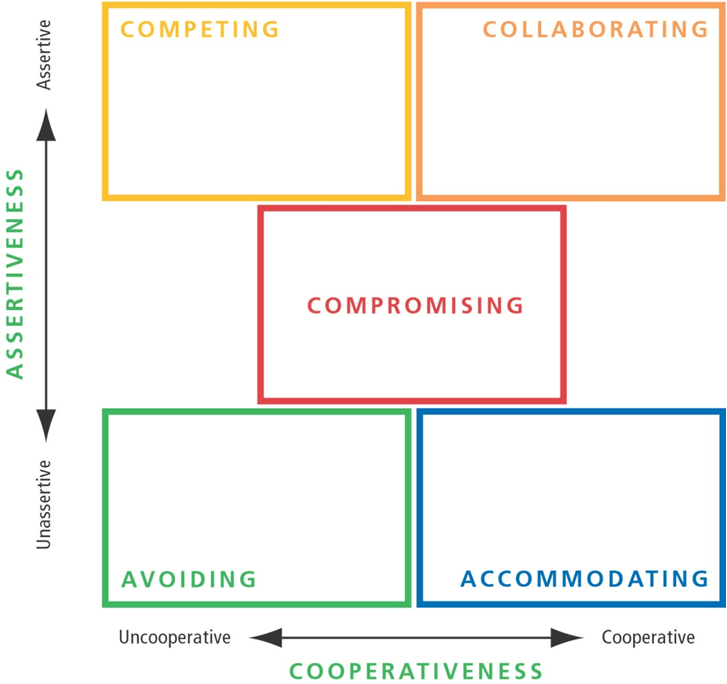
According to Kilmann’s model there are five basic modes of handling conflict that result from the amount of assertiveness and cooperation you employ. Each of us tend to have a natural, default mode we use when faced with conflict, but that particular mode isn’t always appropriate for every situation. The key to effectively managing conflict is to understand which mode is most appropriate for the situation given the outcomes you’re trying to achieve. Here’s a quick snapshot of the five modes of managing conflict:

Avoiding – Taking an unassertive and uncooperative approach to conflict defines the Avoiding mode. Sometimes avoiding conflict is the best move. Perhaps the issue isn’t important enough to address or you need to allow some time to pass to diffuse tensions. But of course avoiding conflict can also be harmful because issues may fester and become more contentious or decisions may be made by default without your input or influence.

Competing – High on assertiveness and low on cooperativeness, the competing mode is appropriate when you need to protect yourself, stand up for important principles, or make quick decisions. Overuse of the competing style tends to result in people around you feeling “bulldozed,” defeated, and un-empowered.

Collaborating – The collaborating mode is the highest use of assertiveness and cooperation and is appropriate when your focus is on merging the perspectives of the parties, integrating solutions, and building relationships. Overusing the collaboration mode can lead to inefficiency,  wasting time, and too much diffusion of responsibility (because if everyone is responsible, then really no one is responsible).

Compromising – Many times people think compromising should be the goal of resolving conflict. I give up something, you give up something, and we agree to settle somewhere in the middle…hogwash! There are certainly times when compromise is the best route, such as when the issue in dispute is only moderately important or you just need a temporary solution. But if you overuse the compromising mode, you can neglect to see the big picture and create a climate of cynicism and low trust because you’re always giving in rather than taking a stand.

Accommodating – This mode is high on cooperativeness and low on assertiveness which is appropriate for situations where you need to show reasonableness, keep the peace, or maintain perspective. If you overuse the accommodating mode, you can find yourself being taken advantage of, having your influence limited, and feeling resentful because you’re always the one making concessions to resolve conflict.

Conflict is a natural part of any relationship, and if managed effectively, can lead to deeper and stronger bonds of trust and commitment. The key is to diagnose the situation, determine your preferred outcomes, and use the mode most appropriate to help you achieve your goals.