Leading with Trust

Seven Gifts for Every Leader This Christmas

Gift BoxSanta is making his list and checking it twice. He’s going to find out which leaders have been naughty or nice. Actually, I think any person willing to step into a position of leading and managing others deserves whatever he/she wants for Christmas! (Try selling that to your spouse or significant other and see how far it gets you!)

If I were to play Santa at the office Christmas party, I’d give the following gifts to leaders:

1. A Sense of Humor – I’ve noticed that a lot of leaders have forgotten how to have a good time at work. Managing people can be quite stressful and it’s easy to get focused on all the problems that have to be solved and the fires that need putting out. This Christmas I would give every leader a healthy dose of fun and laughter as a reminder that you should take your work seriously but yourself lightly. Play a practical joke on your staff, send a funny joke via email, or even better, laugh at yourself the next time you goof up in front of your team. You’d be amazed how a little bit of levity can go a long way toward improving the morale and productivity at work.

2. The Chance to Catch Someone Doing Something Right – Too often we’re on the lookout for people making mistakes and overlook all the times that people are doing things right. Of the hundreds of clients I’ve worked with over the years, not once have I had one say “If my boss praises me one more time I’m going to quit! I’m sick and tired of all the positive feedback I’m getting!” Unfortunately the opposite is true. Most workers can recall many more instances where their mistakes have been pointed out rather than being praised for doing good work. Be on the lookout this holiday season for someone doing something right and spread a little cheer by praising them.

3. An Opportunity to Apologize – Despite our best leadership efforts, there are bound to be times where we make mistakes and let people down. One of the surefire ways to lose trust with people is failing to admit your mistakes or not apologize for a wrong you’ve committed. Take some time this holiday season to examine your relationships to see if there is someone to whom you need to apologize. If so, don’t let the opportunity pass to repair your relationship.

4. A Challenge to Overcome – A challenge to overcome? Why would that be considered a gift? Well, my experience has shown that the times I’ve grown the most as a leader is when I’ve had to deal with a significant challenge that stretched my leadership capabilities and forced me to grow out of my comfort zone. I would bet dollars to donuts (and would be happy losing because I LOVE donuts) that your experience is similar. Challenges are learning opportunities in disguise and it’s these occasions that shape us as leaders.

5. Solitude – Everything in our society works against leaders being able to experience regular solitude in their lives. Technology allows us to always be connected to work which is just one click or touch away. If we aren’t careful it can begin to feel like we’re “on” 24/7. Regular times of solitude helps you recalibrate your purpose, relieve stress, and keep focused on the things that are most important in your life and work.

6. A Promise to Fulfill – Keeping a promise is an opportunity to demonstrate your trustworthiness. The best leaders are trust builders, people who are conscious that every interaction with their employees is an opportunity to nurture trust. This gift comes with a caveat – don’t make a promise that you can’t or don’t intend to keep. Breaking promises is a huge trust buster, and if done repeatedly, can completely destroy trust in a relationship.

7. Appreciation – Leadership is a noble and rewarding profession, yet leaders can go through long stretches of time without hearing a word of thanks or appreciation for their efforts. I would give every leader the gift of having at least one encounter with an employee who shares how much he/she has been positively impacted by the leader and how much the leader is appreciated by his/her team.

There are many more gifts that I’d love to give, but like most of us, I’m on a budget this year. However, I’m curious to know what other gifts you’d give to leaders if you were playing Santa. Feel free to leave a comment with your gift ideas!

Trust – Get It Right On The Inside First!

Trust TilesThis past week I was interviewed by David Witt for the December edition of Blanchard’s Ignite! newsletter. The article appears below.

Trust as a managerial competency? Yes, says Randy Conley, Trust Practice Leader at The Ken Blanchard Companies®, but only as an outward extension of core beliefs held deeply inside. Otherwise you are just going through the motions, attempting to appear trustworthy instead of being trustworthy.

As Conley explains, “People know who they can trust and it’s based on a variety of signals that they pick up. Managers demonstrate trust in their people by the small things they do on a day-to-day basis. It can range from offering praise, increasing responsibility by giving additional tasks, or increasing an employee’s level of autonomy in their role.

“That’s why any skill development has to be built upon a foundation of authenticity. You have to have it right on the inside first. That’s when these tools work best. They help you identify blind spots that might be holding you back as a leader. But it should never be a substitute for genuinely trusting other people.

“This means the person I am with you in the office and at work is the person that I am at home. It’s an alignment of your values. Basically it’s being who you really are. John Wooden, the famous UCLA basketball coach described it best, ‘Character is what you do when no one is watching.’ There needs to be alignment between who you are at work and who you are outside of work.

“There is a fine line between manipulation and authenticity. That’s the shadow aspect of any model or behavioral prescription. For example, if you just approach it as a set of behaviors to influence people, you’re not going to get the traction and results you want. You have to be careful and not treat it from a public relations or spin perspective.”

How do managers get off track?

Everyone knows that trust is important, so how do so many well-meaning managers get off-track when it comes to building trusting relationships?

According to Conley, trust gets off-track when we forget about people and focus only on the product or the result. We get so wrapped up in meeting deadlines, hitting the numbers, or whatever goals we are pursuing that we forget about the relationship aspect.

Of course, goal accomplishment is vital, Conley reminds us, but it’s important to pursue it as a common goal. It’s a “give to get” process. If we neglect that relationship and the human element of it, trust suffers. That results in direct reports thinking to themselves, “All my boss really cares about is whether I get the work done.” That sets up a transactional relationship where everyone is focused on meeting their own needs. You’ll never get the level of performance that a deep commitment to a common goal will produce.

To reverse the process, Conley recommends asking yourself a key leadership question: “Are you here to serve—or be served?” Trusting relationships begin with leaders who are “others focused” instead of “self focused.”

“You can put whatever label you want on it, but it comes from a deeply held belief that my value and role as a leader is to bring out the best in you. It’s not about me, it’s about you. I think that’s the first and foremost core value that people recognize and respond to.” It’s seeing leadership as a higher calling. It’s a lofty aspiration, but that’s a good thing, according to Conley.

“Leaders would be well served to tap into a greater vision of what leadership is, or could be. It’s a noble profession. When you see it that way you recognize that you have to be a trustworthy individual. There’s no room for not being up-front with people, not being competent, or not being dependable and following through on your commitments. It is about having a different vision about what leadership is and what a leader does.”

The benefits of trust

When trust is present in a work relationship there are several benefits. Both sides understand the relationship and are committed to it. Good trustful relationships also create freedom for failure—within limits of course. We’re not talking about permission to fail continuously without consequences, but you are permitted and have a freedom for risk-taking. There’s a level of maturity and acceptance among the manager and direct report that it’s okay to make mistakes because they’ll be viewed as learning opportunities and a chance for us to grow and deepen our relationship.

Trust also builds an atmosphere of open communication that leads to better and more frequent checking in with each other. There’s also a level of confidence in each other’s ability and dependability.

Become a better leader

Conley believes that building trust is the number one leadership competency of the 21st century. But it’s important to remember that it starts on the inside first. In some ways, trust is just an extension of other good management skills and should be woven together with the other things a leader does on a day-to-day basis.

“Trust is a byproduct of all of the other managerial and leadership aspects and activities, duties, and responsibilities that you employ on a day-to-day basis. You become a more trustworthy leader by becoming a better leader.”


Would you like to learn more about trust and its impact on leadership? Then join us for a free webinar!

Building Trust: 3 Keys to Becoming a More Trustworthy Leader

Wednesday, December 12, 2012 9:00–10:00 a.m. Pacific, 12:00–1:00 p.m. Eastern, 5:00–6:00 p.m. UK & GMT

Microphone and HeadphonesTrust continues to be identified as a missing ingredient in today’s workplace. Surveys show that only a small percentage of today’s workers agree that they truly trust their leaders. To ensure high levels of organizational performance, leaders need to tackle trust head-on. The key is to learn how to build trusting relationships that bring out the best in people.

In this webinar, Blanchard Trust Practice Leader Randy Conley will show you how leaders can improve the levels of trust in their organization by identifying potential gaps that trip up even the best of leaders.

Participants will learn how to:

  1. Get it right on the inside. Becoming a more trustful person.
  2. The four leadership behaviors that build or destroy trust.
  3. Three keys to creating trusting relationships.

Don’t miss this opportunity to learn how to raise the level of trust in your organization by increasing the “trust-ability” of your leaders.

Register today!

Leading in the Midst of Tragedy – Thoughts on the Murder-Suicide of KC Chiefs Player Jovan Belcher

Yesterday morning Jovan BelcherJovan Belcher, linebacker for the Kansas City Chiefs football team, murdered Kassandra Perkins, his 22 year-old girlfriend and mother of his 3-month old daughter. He then drove to Arrowhead Stadium where he briefly talked to head coach Romeo Crennel, thanking him for all that he had done to help him, and then committed suicide in his presence as police arrived.

How in the world do you lead in the midst of such tragedy? It’s unfathomable.

Until you have personal experience with it, you don’t realize how pervasive this problem is in our society. Suicide is the third leading cause of death among young people ages 15 to 24. As of 2007 it was the tenth leading cause of death in the U.S. and disproportionately affects men, who are four times as likely to die from suicide, as women.

People I love deeply have wrestled with the specter of suicide. There are times I’ve felt helpless as how to help my loved ones because ultimately their personal welfare is out of my control. I can encourage, support, and listen…but I can’t be in control…and that can be debilitating.

Even though I can’t be in control, I can still lead, and so can you.

We need to shine a light on suicide and bring attention to how people can be helped. If you or someone you love is contemplating suicide, seek help! You are not alone and there are people and resources to give you the help you need.

The National Suicide Prevention Lifeline, 1-800-273 TALK (8255), is available 24 hours a day, 7 days a week. In my local community of San Diego, Up2SD.org offers a wealth of information on suicide, its prevention, and resources available to help those in need.

Seeking help is not a sign of weakness – it’s a sign of immense strength. Reach out to help yourself or those in need. It’s what leaders do.

Addressing Poor Performance is a “Moment of Trust” – 5 Steps for Success

Addressing poor performance with an employee presents a leader with a “moment of trust” – an opportunity to either build or erode trust in the relationship. If you handle the situation with competence and care, the level of trust in your relationship can take a leap forward. Fumble the opportunity and you can expect to lose trust and confidence in your leadership.

Now, I’m the first to admit that having a discussion about an employee’s failing performance is probably the last thing I want to do as a leader. It’s awkward and uncomfortable for both parties involved. I mean, come one, no one likes to hear they aren’t doing a good job. But the way in which the feedback and coaching is delivered can make a huge difference. The key is to have a plan and process to follow. The following steps can help you capitalize on the moment of trust and get an employee’s performance back on track.

1. Prepare – Before you have the performance discussion, you need to make sure you’re prepared. Collect the facts or data that support your assessment of the employee’s low performance. Be sure to analyze the problem by asking yourself questions like:

        1. Was the goal clear?
        2. Was the right training, tools, and resources provided?
        3. Did I provide the right leadership style?
        4. Did the employee receiving coaching and feedback along the way?
        5. Was the employee motivated and confident to achieve the goal?
        6. Did the employee have any personal problems that impacted performance?

2. Describe the problem – State the purpose and ground rules of the meeting. It could sound something like “Susan, I’d like to talk to you about the problem you’re having with the defect rate of your widgets. I’ll give you my take on the problem and then I’d like to hear your perspective.”

Be specific in describing the problem, using the data you’ve collected or the behaviors you’ve observed. Illustrate the gap in performance by explaining what the performance or behavior should be and state what you want to happen now. It could sound something like “In the last week your defect rate has been 18% instead of your normal 10% or less. As I look at all the variables of the situation, I realize you’ve had some new people working on the line, and in a few instances, you haven’t had the necessary replacement parts you’ve needed. Obviously we need to get your rate back under 10%.”

3. Explore and acknowledge their viewpoint – This step involves you soliciting the input of the employee to get their perspective on the cause of the performance problem. Despite the information you’ve collected, you may learn something new about what could be causing or contributing to the decline in performance. Depending on the employee’s attitude, you may need to be prepared for defensiveness or excuses about the performance gap. Keep the conversation focused on the issue at hand and solicit the employee’s ideas for solving the problem.

4. Summarize the problem and causes – Identify points of disagreement that may exist, but try to emphasize the areas of agreement between you and the employee. When you’ve summarized the problem and main causes, ask if the two of you have enough agreement to move to problem solving. It could sound something like “Susan, we both agree that we need to get your defect rate to 10% or below and that you’ve had a few obstacles in your way like new people on the line and occasionally missing replacement parts. Where we see things differently is that I believe you don’t always have your paperwork, parts, and tools organized in advance the way you used to. While we don’t see the problem exactly the same, are we close enough to work on a solution?”

5. Problem solve for the solution – Once you’ve completed step four, you can then problem solve for specific solutions to close the performance gap. Depending on the employee’s level of competence and commitment on the goal or task, you may need to use more or less direction or support to help guide the problem solving process. The outcome of the problem solving process should be specific goals, actions, or strategies that you and/or the employee will put in place to address the performance problem. Set a schedule for checking in on the employee’s progress and be sure to thank them and express a desire for the performance to improve.

A moment of trust is a precious occurrence that you don’t want to waste. Using this five step process can help you address an employee’s poor performance with candor and care that will leave the employee knowing that you respect their dignity, value their contributions, and have their best interests at heart. That can’t help but build trust in the relationship.

Earning a License to Lead – Could You Pass These 5 Areas?

If you had to take a test to earn a license to lead, would you pass? When it comes to leadership, do you know the rules of the road, what all the traffic signs mean, and how to lead in inclement weather? Sadly enough, we probably require more training and knowledge for someone to drive a car than we do for them to lead people!

Now, just as getting a driver’s license doesn’t automatically make you an excellent driver, passing some imaginary leadership exam wouldn’t qualify you as an outstanding leader. However, it would at least signify that you have a basic level of knowledge to lead safely and not harm others (I see a Dilbert cartoon in here somewhere…). Here’s five critical areas where I think people need to have a basic level of competency in order to earn a license to lead:

1. Building Trust — If you know me or have read anything on this blog, you know that I’m a trust activist (a phrase recently coined by my friend Jon Mertz), and I believe that learning to build high-trust relationships is the defining competency of successful leaders in the 21st century. Being a person of integrity, competence, compassion, and reliability are all crucial elements of being trustworthy. Establishing trust in relationships is the ticket of admission for being a leader, it allows you to get in the game. Once you’re in the game you have the potential to make some great plays if you can do the other things in this list, which by the way, continually build and sustain trust in your leadership.

2. Setting clear goals — Whether it’s communicating a clear vision on the macro-level, or establishing specific goals and actions on a micro-level, good leaders understand that their people need a clear idea of the direction they’re heading and what they’re supposed to do. You’d be surprised at the number of leaders I speak with that express frustration over their people not performing up to expectations and readily admit that they haven’t established or communicated those expectations in the first place!

3. Flexing leadership style to the situation — One size doesn’t fit all when it comes to leadership. Depending on an employee’s level of competence and commitment on a given task or goal, leaders need to use a style that matches the needs of the employee. There will be times where leaders need to be more directive in their style when employees need specific instruction, and other times leaders need to use a more supportive style when the employee knows what to do but just needs a little reassurance. Treating everyone the same in all circumstances is not being “fair,” it’s being one-dimensional.

4. Listening — Just as a good driver pays attention to conditions of the road, pedestrians, and other drivers, top leaders pay attention to how their employees are doing by being a good listener. It’s amazing what you can learn about people by simply listening to them, but being a good listener takes effort. You have to learn to concentrate on what’s being said (or not said), being present in the moment and not letting your mind drift, checking your understanding by asking questions or paraphrasing, and listening to understand and be influenced rather than just waiting to make a counterpoint.

5. Giving feedback — Ken Blanchard likes to say that “Feedback is the breakfast of champions!” For leaders to develop their people into champions, they have to be comfortable in giving both positive and negative feedback. Generally speaking, it’s a whole lot easier (and fun) to deliver positive feedback. Everyone likes delivering good news! It’s a completely different story when it comes to delivering negative feedback. Most of us fall prey to sugar-coating negative feedback or being overly general and vague when discussing it with an employee. I’ve learned in my leadership journey that I do a disservice to the employee, and myself, when I sugar coat feedback. People often don’t pick up on the subtle clues we use when discussing tough situations so it’s better to deliver the feedback with candor and care so the employee knows exactly what they’re doing wrong and how they can improve.

These may be the “Big Five” when it comes to understanding the basics of leadership and earning a license to lead other people, but I know there are many other competencies that deserve to be on the test. What else would you test for before granting someone a license to lead? Feel free to join the discussion by leaving a comment.

Four Ways To Build Trust Through Better Listening

It’s easy for leaders to fall into the trap of thinking they need to have the answer to every problem or situation that arises. After all, that’s in a leader’s job description, right? Solve problems, make decisions, have answers…that’s what we do! Why listen to others when you already know everything?

Good leaders know they don’t have all the answers. They spend time listening to the ideas, feedback, and thoughts of their people, and they incorporate that information into the decisions and plans they make. When a person feels listened to, it builds trust, loyalty, and commitment in the relationship. Here are some tips for building trust by improving the way you listen in conversations:

  • Don’t interrupt – It’s rude and disrespectful to the person you’re speaking with and it conveys the attitude, whether you mean it or not, that what you have to say is more important than what he or she is saying.
  • Make sure you understand – Ask clarifying questions and paraphrase to ensure that you understand what the person is trying to communicate. Generous and empathetic listening is a key part of Habit #5 – Seek first to understand, then to be understood – of Covey’s famous Seven Habits of Highly Effective People.
  • Learn each person’s story – The successes, failures, joys, and sorrows that we experience in life weave together to form our “story.” Our story influences the way we relate to others, and when a leader takes time to understand the stories of his followers, he has a much better perspective and understanding of their motivations. Chick-fil-a uses an excellent video in their training programs that serves as a powerful reminder of this truth.
  • Stay in the moment – It’s easy to be distracted in conversations. You’re thinking about the next meeting you have to run to, the pressing deadline you’re up against, or even what you need to pick up at the grocery store on the way home from work! Important things all, but they distract you from truly being present and fully invested in the conversation. Take notes and practice active listening to stay engaged.

My grandpa was fond of saying “The Lord gave you two ears and one mouth. Use them in that proportion.” Leaders can take a step forward in building trust with those they lead by speaking less and listening more. You might be surprised at what you learn!

The Great Communicator – Four Ways Ronald Reagan Built Trust

On Tuesday, November 6th, those of us in the United States get to participate in the great American experiment of democratic self-government when we go to the polls to cast our ballot in the presidential election. One of the key roles of the President of the United States, and for any leader in general, is to inspire trust in his or her followers. Few have done it better than Ronald Reagan, the “Great Communicator.”

The first time I was old enough to vote in a presidential election was in 1984 when Reagan defeated Walter Mondale in a landslide, earning 525 of the 538 electoral votes, the highest total in history. Reagan communicated in such a way that allowed most Americans to trust and follow him and to believe in the direction he wanted to take the country. Far from being an exhaustive treatise on the Reagan presidency, here’s four ways that Reagan built trust through his communications. Leaders in any organization at any level can benefit from applying these principles:

He had clear values – Whether you agreed with him or not, Reagan had very clear values that drove his actions. His view on the supremacy of individual freedom and the limited role of government was clearly articulated when he said, “I hope we once again have reminded people that man is not free unless government is limited. There’s a clear cause and effect here that is as neat and predictable as a law of physics: As government expands, liberty contracts.” Trusted leaders have a keen sense of their own personal values and are not hesitant to communicate them to their people and make decisions in alignment with those values.

He helped people believe in themselves – Reagan’s belief in the capabilities of individual Americans inspired a sense of confidence in people. When he used phrases such as “It’s morning again in America” or “America is back and standing tall,” he communicated a sense of belief in Americans that had been lacking in prior years. Leaders build trust with their people when they express their belief and confidence in them. Don’t ever let an opportunity go by to build someone up.

He had an authentic sense of humor – One of Reagan’s most endearing qualities was his sense of humor. He, along with other successful leaders, knew how to take his work seriously but himself lightly. Reagan frequently took heat for being one of America’s oldest presidents yet he didn’t become bitter about the criticism. He said “Thomas Jefferson once said, ‘We should never judge a president by his age, only by his works.’ And ever since he told me that, I stopped worrying.” Leaders will always be successful when they focus on being a first-rate version of themselves rather than a second-rate version of someone else.

He had a clear vision – Reagan frequently talked about America becoming the “shining city on a hill,” a vision of American exceptionalism, a vision of America reaching its full potential in all aspects of its existence and being an example for the world to model. In his farewell address in January 1989, Reagan said. “I’ve spoken of the shining city all my political life, but I don’t know if I ever quite communicated what I saw when I said it. But in my mind it was a tall proud city built on rocks stronger than oceans, wind-swept, God-blessed, and teeming with people of all kinds living in harmony and peace, a city with free ports that hummed with commerce and creativity, and if there had to be city walls, the walls had doors and the doors were open to anyone with the will and the heart to get here. That’s how I saw it and see it still…”

Regan’s vision for America captured the hearts and minds of its citizens and tapped into an innate need that every one of us has; the need to be part of something bigger than ourselves. One of a leader’s primary responsibilities is to clearly articulate the vision of his or her team. Why does your team exist? What is your mission? What are you trying to accomplish? Answer those questions and clearly communicate them to your team and you’ll take a big step toward creating a trusted and loyal followership.

Ten Signs You Might Be A Frankenboss

Frankenbossnoun; 1. A mean boss that terrorizes his or her employees; 2. A boss whose behavior closely resembles that of a half-brained monster; 3. A jerk.

With Halloween just three days away, I told my wife that I wanted to write an article about the bad, clueless behaviors that make a leader a “Frankenboss” (see definition above). Sadly enough, it only took us about 3 minutes to brainstorm the following list. If any of these describe your leadership style, you might want to take a look in the mirror and examine the face that’s peering back at you…you might have bolts growing out the sides of your neck.

You might be a Frankenboss if you…

1. Lose your temper – Some leaders think by yelling or cursing at employees they are motivating them. Baloney! Losing your temper only shows a lack of maturity and self-control. There’s no room for yelling and screaming in today’s workplace. Our society has finally awoken to the damaging effects of bullying in our school system so why should it be any different at work? No one should have to go to work and fear getting reamed out by their boss. If you have troubles controlling your temper then do something to fix it.

2. Don’t follow through on your commitments – One of the quickest ways to erode trust with your followers is to not follow through on commitments. As a leader, your people look to you to see what behavior is acceptable, and if you have a habit of not following through on your commitments, it sends an unspoken message to your team that it’s ok for them to not follow through on their commitments either.

3. Don’t pay attention, multi-task, or aren’t “present” in meetings – Some studies say that body language accounts for 50-70% of communication. Multi-tasking on your phone, being preoccupied with other thoughts and priorities, or simply exhibiting an attitude of boredom or impatience in meetings all send the message to your team that you’d rather be any place else than meeting with them. It’s rude and disrespectful to your team to act that way. If you can’t be fully engaged and devote the time and energy needed to meet with your team, then be honest with them and work to arrange your schedule so that you can give them 100% of your focus. They deserve it.

4. Are driven by your Ego – The heart of leadership is about giving, not receiving. Self-serving leaders may be successful in the short-term, but they won’t be able to create a sustainable followership over time. I’m not saying it’s not important for leaders to have a healthy self-esteem because it’s very important. If you don’t feel good about yourself, it’s going to be hard to generate the self-confidence needed to lead assertively, but there is a difference between self-confidence and egoism. Ken Blanchard likes to say that selfless leaders don’t think less of themselves, they just think about themselves less.

5. Avoid conflict – Successful leaders know how to effectively manage conflict in their teams. Conflict in and of itself is not a bad thing, but our culture tends to have a negative view of conflict and neglect the benefits of creativity, better decision-making, and innovation that it can bring. Frankenbosses tend to either completely avoid conflict by sweeping issues under the rug or they go to the extreme by choosing to make a mountain out of every molehill. Good leaders learn how to diagnose the situation at hand and use the appropriate conflict management style.

6. Don’t give feedback – Your people need to know how they’re performing, both good and bad. A hallmark of trusted leaders is their open communication style. They share information about themselves, the organization, and they keep their employees apprised of how they’re performing. Meeting on a quarterly basis to review the employee’s goals and their progress towards attaining those goals is a good performance management practice. It’s not fair to your employees to give them an assignment, never check on how they’re doing, and then blast them with negative feedback when they fail to deliver exactly what you wanted. It’s Leadership 101 – set clear goals, provide the direction and support the person needs, provide coaching and feedback along the way, and then celebrate with them when they achieve the goal.

7. Micromanage – Ugh…even saying the word conjures up stress and anxiety. Micromanaging bosses are like dirty diapers – full of crap and all over your a**. The source of micromanagement comes from several places. The micromanager tends to think their way is the best and only way to do the task, they have control issues, they don’t trust others, and generally are not good at training, delegating, and letting go of work. Then they spend their time re-doing the work of their subordinates until it meets their unrealistic standards and they go around complaining about how overworked and stressed-out they are! Knock it off! A sign of a good leader is what happens in the office when you’re not there. Are people fully competent in the work? Is it meeting quality standards? Are they behaving like good corporate citizens? Micromanagers have to learn to hire the right folks, train them to do the job the right way, monitor their performance, and then get out of their way and let them do their jobs.

8. Throw your team members under the bus – When great bosses experience success, they give the credit to their team. When they encounter failure, they take personal responsibility. Blaming, accusing, or making excuses is a sign of being a weak, insecure leader. Trusted leaders own up to their mistakes, don’t blame others, and work to fix the problem. If you’re prone to throwing your team members under the bus whenever you or they mess up, you’ll find that they will start to withdraw, take less risk, and engage in more CYA behavior. No one likes to be called out in front of others, especially when it’s not justified. Man up and take responsibility.

9. Always play by the book – Leadership is not always black and white. There are a lot of gray areas when it comes to being a leader and the best ones learn to use good judgment and intuition to handle each situation uniquely. There are some instances where you need to treat everyone the same when it comes to critical policies and procedures, but there are also lots of times when you need to weigh the variables involved and make tough decisions. Too many leaders rely upon the organizational policy manual so they don’t have to make tough decisions. It’s much easier to say “Sorry, that’s the policy” than it is to jump into the fray and come up with creative solutions to the problems at hand.

10. You practice “seagull” management – A seagull manager is one who periodically flies in, makes a lot of noise, craps all over everyone, and then flies away. Good leaders are engaged with their team members and have the pulse of what’s going on in the organization. That is much harder work than it is to be a seagull manager, but it also earns you much more respect and trust from your team members because they know you understand what they’re dealing with on a day-to-day basis and you have their best interests in mind.

I’m sure you’ve had your own personal experiences with a Frankenboss. What other behaviors would you add to this list? Feel free to leave a comment and share your thoughts.

Lance Armstrong: It’s Not About the Bike – It’s About the Truth

If life was like a bicycle, Lance Armstrong’s suddenly has two flat tires.

On the heels of being slapped with a lifetime ban from cycling and stripped of his seven Tour de France titles by the U.S. Anti Doping Agency a few weeks ago, Armstrong resigned Wednesday as chairman of the LIVESTRONG Foundation. His resignation came as a result of the negative fallout surrounding the USADA releasing its 200 page report detailing their evidence of Armstrong’s use of performance enhancing drugs (PED) and his role in what USADA dubbed “the most sophisticated, professional and successful doping program that sport has ever seen.”

Armstrong has been dropped by several of his top sponsors including Anheuser-Busch, Trek, 24-Hour Fitness, Radio Shack, and most importantly, Nike. “Due to the seemingly insurmountable evidence that Lance Armstrong participated in doping and misled Nike for more than a decade, it is with great sadness that we have terminated our contract with him,” the company said in a statement. “Nike does not condone the use of illegal performance enhancing drugs in any manner.”

I don’t know Lance Armstrong. I haven’t even read his book. But it seems clear that he’s broken trust with a lot of people who have admired him, both for his sporting accomplishments as well as his personal comeback from cancer and his efforts to fight the disease on a global basis. At this point in Armstrong’s life, he refuses to acknowledge that he’s broken trust, which is the first step in the process to restore his credibility with others. Once he’s able to acknowledge the situation, he needs to admit his wrongdoing, apologize to his legions of supporters, and then begin the process of making amends, whatever that may look like.

There is no denying the tremendous accomplishments of the LIVESTRONG Foundation and the wonderful support they provide to so many people in the cancer community, yet Lance Armstrong’s personal integrity seems to be completely incongruent with the noble mission he helped found.

Integrity means you tell the truth. You don’t lie. You don’t cheat. You have honorable values and live your life in accordance with those values. You walk the talk. You’re ethical. You’re a person of character.

That’s what it means to LIVESTRONG.

Heart to Heart Talks – Three Steps to Discuss the Elephant in the Room

At the root of many of our interpersonal or team conflicts is a failure to communicate. Sometimes the problem is that information isn’t shared broadly enough and people become resentful because they weren’t included. Other times we say things that come out wrong and people are offended, even though we may have had good intentions behind our message. Regardless of how the situation was created, if we don’t take the time to thoughtfully address it, the miscommunication evolves into the “elephant in the room” that everyone knows is present but isn’t willing to address.

Recently I worked with a client where the elephant in the room had been present for nearly a year. The issue within this team had led to a fracture in what were previously very close relationships, had tarnished the team’s reputation within the organization, and was causing strife and turmoil that was affecting the team’s performance. Everyone on the team knew the elephant was in the room, but no one wanted to talk about it.

To break the communication logjam and get the team back on the path to restoring an environment of openness, trust, and respect, I used a facilitated discussion process called Heart to Heart Talks, adapted from Layne and Paul Cutright’s book Straight From the Heart. If the participants are committed to the health and success of the relationship, and approach this process with a desire to be authentic and vulnerable, it can be a powerful way to discuss difficult issues and allow everyone to be heard.

The process involves three rounds of discussions and the speaker and listener have very specific roles. The speaker has to use a series of lead-in statements that structure the context of how they express their thoughts and emotions. In order to let the speaker know he/she has been heard, understood, and allow additional information to be shared, the listener can only respond with the following statements:

  • Thank you.
  • I understand.
  • Is there more you would like to say about that?
  • I don’t understand. Could you say that in a different way?

The first round involves a series of “Discovery” statements designed to create openness among the participants and to learn more about each others’ perspectives. The speaker can use the following sentence starters:

  • Something I want you to know about me…
  • Something that’s important to me is…
  • Something that’s challenging for me right now is…

The second round comprises “Clearing” statements that allow for the release of fears, anxiety, stress, and to increase trust. The speaker can use the following sentence stems:

  • Something I’ve been concerned about is…
  • Something I need to say is…
  • A feeling I’ve been having is…
  • Something I’m afraid to tell you is…

The third round involves “Nurturing” statements that create mental and emotional well-being in the relationship. These statements allow the participants to put closure to the difficult issues that were shared and to express appreciation for each other that sets the stage for moving forward in a positive fashion. The speaker can use the following phrases:

  • Something I appreciate about you is…
  • Something I value about you is…
  • Something I respect about you is…

The facilitator can structure the process in a number of ways, but the important thing is to establish a rhythm for each round where the speaker gets a defined amount of time to share (using the lead-in statements) and the listener responds after each statement. It’s important for the listener to respond each time because it sets the proper rhythm for the discussion and validates the thoughts being shared by the speaker. The speaker should be encouraged to share whatever comes to mind without censoring his/her thoughts or saying what he/she thinks the other person wants to hear. If the speaker can’t think of anything to share, he/she can say “blank” and then repeat one of the sentence starters. Encourage the participants to keep the process moving and the thoughts will flow more quickly. At the conclusion of the three rounds, it’s important to close the discussion with a recap of the desired outcomes and any action items the participants want to pursue.

As “Captain”, the prison warden in the movie Cool Hand Luke, famously said to Paul Newman’s character, “What we have here is (a) failure to communicate.” That’s often the case when it comes to interpersonal or team conflicts, and using the Heart to Heart process can help people confront the elephant in the room that everyone knows is there but is afraid to discuss.

Conflict gets a bad rap. Most people tend to view conflict as a bad thing, automatically assuming it has to be an adversarial win or lose situation. The reality is that conflict is inevitable in relationships and it isn’t inherently a negative thing. It depends if you choose to manage the conflict or let the conflict manage you.

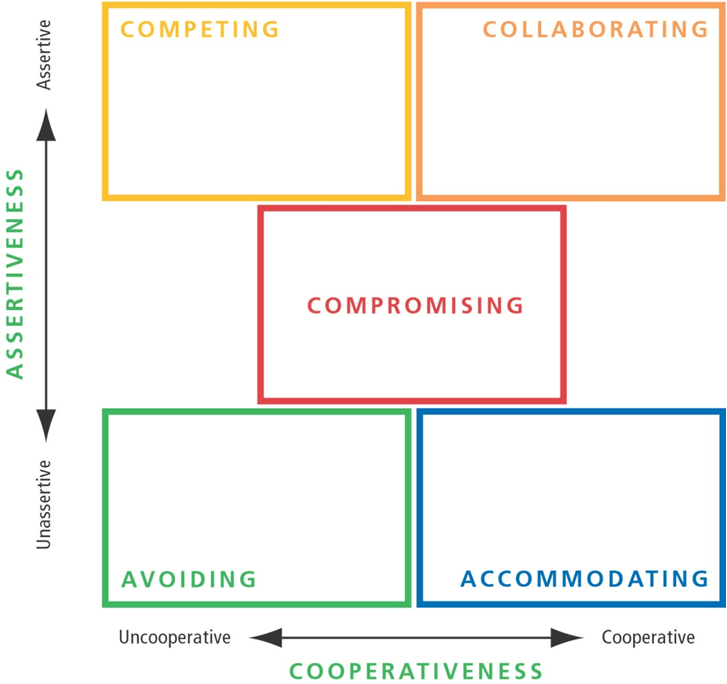
I’m a fan of the Thomas Kilmann model of conflict management because of its dispassionate approach to the topic and the practical strategies it offers for its followers. Kilmann defines conflict as any situation where your concerns or desires differ from those of another person. That can be as simple as deciding where to go for dinner with your spouse to something as complex as brokering the details of a huge corporate merger.

According to Kilmann’s model there are five basic modes of handling conflict that result from the amount of assertiveness and cooperation you employ. Each of us tend to have a natural, default mode we use when faced with conflict, but that particular mode isn’t always appropriate for every situation. The key to effectively managing conflict is to understand which mode is most appropriate for the situation given the outcomes you’re trying to achieve. Here’s a quick snapshot of the five modes of managing conflict:

Avoiding – Taking an unassertive and uncooperative approach to conflict defines the Avoiding mode. Sometimes avoiding conflict is the best move. Perhaps the issue isn’t important enough to address or you need to allow some time to pass to diffuse tensions. But of course avoiding conflict can also be harmful because issues may fester and become more contentious or decisions may be made by default without your input or influence.

Competing – High on assertiveness and low on cooperativeness, the competing mode is appropriate when you need to protect yourself, stand up for important principles, or make quick decisions. Overuse of the competing style tends to result in people around you feeling “bulldozed,” defeated, and un-empowered.

Collaborating – The collaborating mode is the highest use of assertiveness and cooperation and is appropriate when your focus is on merging the perspectives of the parties, integrating solutions, and building relationships. Overusing the collaboration mode can lead to inefficiency,  wasting time, and too much diffusion of responsibility (because if everyone is responsible, then really no one is responsible).

Compromising – Many times people think compromising should be the goal of resolving conflict. I give up something, you give up something, and we agree to settle somewhere in the middle…hogwash! There are certainly times when compromise is the best route, such as when the issue in dispute is only moderately important or you just need a temporary solution. But if you overuse the compromising mode, you can neglect to see the big picture and create a climate of cynicism and low trust because you’re always giving in rather than taking a stand.

Accommodating – This mode is high on cooperativeness and low on assertiveness which is appropriate for situations where you need to show reasonableness, keep the peace, or maintain perspective. If you overuse the accommodating mode, you can find yourself being taken advantage of, having your influence limited, and feeling resentful because you’re always the one making concessions to resolve conflict.

Conflict is a natural part of any relationship, and if managed effectively, can lead to deeper and stronger bonds of trust and commitment. The key is to diagnose the situation, determine your preferred outcomes, and use the mode most appropriate to help you achieve your goals.

Want to Build Trust? Get Naked!

Establishing trusted relationships is a critical imperative for leadership success today, and a key way to develop trust with those you lead is by being vulnerable. I’m not talking about getting on the proverbial therapist’s couch and telling your direct reports all of your deep, inner secrets. I’m talking about disclosing appropriate and relevant amounts of information about yourself over the course of time as relationships grow and develop.

In his book, Getting Naked, author Patrick Lencioni discusses three fears that keep us from being vulnerable…from “getting naked.” Lencioni discusses these fears in the context of sabotaging client relationships, but the lessons are equally relevant for leaders in regards to developing trust with their followers. Leaders sabotage trust by giving in to the following fears:

  • The fear of losing followership (“business” in the context of Lencioni’s parable about client relationships) – The business of a leader is influencing others to achieve their personal goals and those of the organization. Sometimes leaders fear being vulnerable because it could be perceived as a sign of weakness, or evidence that their leadership isn’t needed. Leaders can conquer this fear by being “other-focused” rather than self-focused and remembering that their top priority is to help others succeed. When your followers believe you have their best interests in mind, they will trust you and give you the discretionary energy and commitment that is essential for organizational success.
  • The fear of being embarrassed – Many leaders are afraid they will be embarrassed by not having all the right answers or being proven wrong in public. To prevent embarrassment, leaders play their cards close to the vest, don’t share information with others, and don’t allow participation in decision-making. Creating a culture where mistakes are celebrated as learning opportunities, risk taking is encouraged, and stupid or obvious questions encouraged will help allay this fear and lead to higher levels of trust in leaders’ relationships.
  • The fear of feeling inferior – This fear is rooted in the leader’s ego. Ken Blanchard likes to say that EGO stands for “edging good out.” Leaders do this by focusing on their reputation and social standing and pushing all other interests aside. These kinds of leaders often derive their self-worth from the successes they achieve and the applause of adoring fans. Trusted leaders overcome this fear by cultivating an attitude of humility. Humility doesn’t mean that you think less of yourself. It means you think about yourself less. You build trust by keeping the focus on the goals of the team and the needs of your followers and not worrying about who gets the credit for success.

The bottom line effect of getting naked with your followers is that you’ll develop trusted relationships that will fuel the success of your team and organization.

“There can be no vulnerability without risk; there can be no community without vulnerability; there can be no peace, and ultimately no life, without community.”
M. Scott Peck