Leading with Trust

Thanksgiving Special: 10 Super Easy Ways to Tell Your Employees “Thank You”

Telling an employee “thank you” is one of the most simple and powerful ways to build trust, yet it doesn’t happen near enough in the workplace.

Whenever I conduct trust workshops with clients and discuss the role that rewards and recognition play in building trust, I will ask participants to raise their hands if they feel like they receive too much praise or recognition on the job. No one has ever raised a hand.

So in an effort to equip leaders to build trust and increase recognition in the workplace, and with the U.S. Thanksgiving holiday just a few days away, I thought I’d share ten easy, no to low-cost ways to tell your employees “thank you.” I’ve used many of these myself and can attest to their effectiveness.

In old school, classic David Letterman Late Night style…The Top 10 Super Easy Ways to Tell Employees “Thank You:”

10. Let them leave work early – This may not be feasible in all work environments, but if you’re able to do it, a surprise treat of allowing people to leave early does wonders for team morale and well-being. I use this technique occasionally with my team, usually when they’ve had the pedal to the metal for a long period of time, or if we have a holiday weekend coming up. Allowing folks to get a head start on the weekend or a few hours of unexpected free time shows you recognize and appreciate their hard work and that you understand there’s more to life than just work.

9. Leave a “thank you” voice mail message – Don’t tell my I.T. department, but I’ve got voice mails saved from over ten years ago that were sent to me by colleagues who took the time to leave me a special message of praise. The spoken word can have a tremendous impact on individuals, and receiving a heartfelt message from you could positively impact your employees in ways you can’t imagine.

8. Host a potluck lunch – You don’t have to take the team to a fancy restaurant or have a gourmet meal catered in the office (which is great if you can afford it!), you just need to put a little bit of your managerial skills to practice and organize a potluck lunch. Sharing a meal together allows people to bond and relax in a casual setting and it provides an excellent opportunity for you to say a few words of thanks to the team and let them know you appreciate them.

7. Give a small token of appreciation – Giving an employee a small memento provides a lasting symbol of your appreciation, and although it may cost you a few bucks, it’s well worth the investment. I’m talking about simple things like giving nice roller-ball ink pens with a note that says “You’ve got the write stuff,” or Life Savers candies with a little note saying “You’re a hole lot of fun,” or other cheesy, somewhat corny things like that (believe me, people love it!). I’ve done this with my team and I’ve had people tell me years later how much that meant to them at the time.

6. Have your boss recognize an employee – Get your boss to send an email, make a phone call, or best-case scenario, drop by in-person to tell one of your employees “thank you” for his/her work. Getting an attaboy from your boss’ boss is always a big treat. It shows your employee that you recognize his/her efforts and you’re making sure your boss knows about it too.

5. Hold an impromptu 10 minute stand up meeting – This could be no or low-cost depending on what you do, but I’ve called random 10 minute meetings in the afternoon and handed out popsicles or some other treat and taken the opportunity to tell team members “thank you” for their hard work. The surprise meeting, combined with a special treat, throws people out of their same ol’, same ol’ routine and keeps the boss/employee relationship fresh and energetic.

4. Reach out and touch someone – Yes, I’m plagiarizing the old Bell Telephone advertising jingle, but the concept is right on. Human touch holds incredible powers to communicate thankfulness and appreciation. In a team meeting one time, my manager took the time to physically walk around the table, pause behind each team member, place her hands on his/her shoulders, and say a few words about why she was thankful for that person. Nothing creepy or inappropriate, just pure love and respect. Unfortunately, most leaders shy away from appropriate physical contact in the workplace, fearful of harassment complaints or lawsuits. Whether it’s a handshake, high-five, or fist bump, find appropriate ways to communicate your thanks via personal touch.

3. Say “thank you” – This seems like a no-brainer given the topic, but you would be amazed at how many people tell me their boss doesn’t take the time to express thanks. Saying thank you is not only the polite and respectful thing to do, it signals to your people that they matter, they’re important, valuable, and most of all, you care.

2. Send a thank you note to an employee’s family – A friend of mine told me that he occasionally sends a thank you note to the spouse/significant other/family of an employee. He’ll say something to the effect of “Thank you for sharing your husband/wife/dad/mother with us and supporting the work he/she does. He/she a valuable contributor to our team and we appreciate him/her.” Wow…what a powerful way to communicate thankfulness!

…and the number one Easy, No to Low Cost Way to Tell Employees “Thank You” is…

1. Give a handwritten note of thanks – Some things never go out of style and handwritten thank you notes are one of them. Emails are fine, voice mails better (even made this list!), but taking the time to send a thoughtful, handwritten note says “thank you” like no other way. Sending handwritten letters or notes is a lost art in today’s electronic culture. When I want to communicate with a personal touch, I go old school with a handwritten note. It takes time, effort, and thought which is what makes it special. Your employees will hold on to those notes for a lifetime.

What other ways to say “thank you” would you add to this list? Please a share your thoughts by leaving a comment.

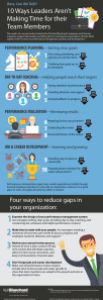
10 Ways Leaders Aren’t Making Time for Their Team Members (Infographic)

Work Conversations Infographic CoverPerformance planning, coaching, and review are the foundation of any well-designed performance management system, but the results of a recent study suggest that leaders are falling short in meeting the expectations of their direct reports.

Researchers from The Ken Blanchard Companies teamed up with Training magazine to poll 456 human resource and talent-management professionals. The purpose was to determine whether established best practices were being leveraged effectively.

Performance-Management-Gap-InfographicThe survey found gaps of 20-30 percent between what employees wanted from their leaders and what they were experiencing in four key areas: Performance Planning (setting clear goals), Day-to-Day Coaching (helping people reach their targets), Performance Evaluation (reviewing results), and Job and Career Development (learning and growing.)

Use these links to download a PDF or PNG version of a new infographic that shows the four key communication gaps broken down into ten specific conversations leaders should be having with their team members.

Are your leaders having the performance management conversations they should be? If you find similar gaps, address them for higher levels of employee work passion and performance.

You can read more about the survey (and see the Blanchard recommendations for closing communication gaps) by accessing the original article, 10 Performance Management Process Gaps, at the Training magazine website.

(This post was originally written and published by David Witt at LeaderChat.org.)

The Most Successful Apologies Have These 8 Elements

sorryI’m pretty good at apologizing and I think it’s primarily because of two reasons:

  1. I’ve been married for over 28 years.
  2. I mess up a lot.

That means I get a lot of practice apologizing. I’ve logged way more than 10,000 hours perfecting my craft, so by Malcolm Gladwell’s measurement, I’m pretty much the world’s foremost expert on apologies. The fact my wife is a loving and forgiving woman doesn’t hurt, either.

More than 28 years experience has shown me there are eight essential elements of an effective apology:

1. Accept responsibility for your actions – If you screwed up, admit it. Don’t try to shirk your responsibility or shift the blame to someone else. Put your pride aside and own your behavior. This first step is crucial to restoring trust with the person you offended.

2. Pick the right time to apologize – It’s a cliché, but true – timing is everything. You can follow the other seven guidelines to a tee, but if you pick a bad time to deliver your apology, all of your hard work will be for naught. Depending on the severity of the issue, you may need to delay your apology to allow the offended person time to process his/her emotions. Once he/she is mentally and emotionally ready to hear your apology, make sure you have the necessary privacy for the conversation and the physical environment is conducive to the occasion.

3. Say ‘”I’m sorry,” not “I apologize” – What’s the difference? The word sorry expresses remorse and sorrow for the harm caused the offended person, whereas apologize connotes regret for your actions. There’s a big difference between the two. See #4 for the reason why this is important.

4. Be sincere and express empathy for how you hurt the other person – Along with saying I’m sorry, this step is critical for letting the offended person know you acknowledge, understand, and regret the hurt you caused. Make it short and simple: “I’m sorry I was late for our dinner date. I know you were looking forward to the evening, and being late disappointed you and made you feel unimportant. I feel horrible about hurting you that way.”

5. Don’t use conditional language – Get rid of the words if and but in your apologies. Saying “I’m sorry if…” is a half-ass, conditional apology that’s dependent on whether or not the person was offended. Don’t put it on the other person. Just man up and say “I’m sorry.” When you add the word but at the end of your apology (“I’m sorry, but…”) you’re starting down the road of excuses for your behavior. Don’t go there. See #6.

6. Don’t offer excuses or explanations – Keep your apology focused on what you did, how it made the other person feel, and what you’re going to do differently in the future. Don’t try to make an excuse for your behavior or rationalize why it happened. If there is a valid reason that explains your behavior, it will likely come out during the apology discussion. But let the other person go there first, not you.

7. Listen – This is perhaps the most important point of the eight and one that’s often overlooked. After you’ve made your apology, close your mouth and listen. Let the offended person share his/her feelings, vent, cry, yell, laugh, scream…whatever.  Acknowledge the person’s feelings (“I understand you’re upset”…”I see I disappointed you”…”I know it was hurtful”), but resist the urge to keep explaining yourself or apologizing over and over again. I’m not suggesting you become an emotional punching bag for someone who is inappropriately berating you; that’s not healthy for either party. But many times the awkwardness and discomfort of apologizing causes us to keep talking when we’d be better off listening.

8. Commit to not repeating the behavior – Ultimately, an apology is only as effective as your attempt to not repeat the behavior. No one is perfect and mistakes will be made, but a sincere and earnest apology includes a commitment to not repeating the behavior that caused harm in the first place. Depending on the severity of the offense, this may include implementing a plan or process such as counseling or accountability groups. For minor offenses it’s as simple as an intentional effort to not repeat the hurtful behavior.

So there you go. The Great 8 of giving effective apologies, honed from years of groveling…err…apologizing for my mistakes. What do you think? Are there other tips you would add? Feel free to leave a comment with your thoughts.

5 Common Leadership Behaviors That Crush The Spirits of Employees

crushedI admit it. Sometimes when I’m under the gun at work and feeling the pressure of all my responsibilities, I can get tunnel vision about accomplishing my own goals and forget how my behavior is influencing others. It’s not that I’m trying to be insensitive to people, I’m just not being mindful or intentional in my actions.

I don’t think I’m alone in this regard. It happens to every leader from time to time when we’re under stress and reacting in the moment. It’s in these occasions that we have a tendency to focus on the objectives of the task and minimize the people concerns. Who cares how people feel as long as the job gets done, right? Well, consistently behaving this way may help you check items off your to-do list, but it can come at the cost of crushing the spirits of your team members in the process. Here are five common spirit-crushing behaviors leaders should avoid:

Micromanaging – Control is the opposite of trust, and micromanaging sends the message to your team members that you don’t trust them to do their jobs. It’s common for leaders to exert control when under stress because they feel more secure being able to directly influence the outcome. However, micromanaging saps the initiative of your team to the point where they stop taking responsibility because they know you’re going to step in and take charge.

Demeaning Others – Leaders demean others through careless comments that degrade their dignity, status, or character. An example is when a leader says or does things that communicates people are “less than” they really are. Stereotypical examples are asking an administrative assistant to pick up your dry cleaning or get you a cup of coffee, tasks clearly outside their job description.

Ignoring Others’ Contributions – We all have an innate need to be appreciated and it doesn’t take much for leaders to acknowledge the efforts of team members. Many times all it takes is saying thank you. A pattern of not recognizing the good work of others will eventually turn team members against you. People will develop a mindset of doing the minimum amount of work acceptable because “they don’t appreciate me going above and beyond.”

Intimidating or Coercing Others – This behavior is a holdover from the days of Command and Control leadership, but unfortunately, too many leaders still rely on this tactic to get work accomplished. I think there are two main reasons why this is the case. First, some leaders truly don’t know any better. They believe their job as the “boss” is to tell other people what to do, how to do it, and when to do it. Secondly, it’s the path of least resistance. When leaders are stressed and short on time and patience, getting work done by intimidating or coercing others seems the most expedient thing to do. It may work for you once or twice, but intimidating others will not only crush their spirits, it will create enemies that actively work against you and not with you.

Playing favorites – One of the most influential factors that crush a person’s spirit is being treated unfairly. We are hardwired with a desire for justice, and when we feel we’re aren’t being treated justly, it causes a variety of emotions ranging from defensiveness and anger to cynicism and despair. Leaders can be fair by treating people equitably and ethically. Being equitable means people receive what they deserve based on the circumstances, and being ethical means the leaders behavior is alignment with the values of the organization and it’s policies and procedures.

I believe most leaders have positive intentions. There are very few leaders who wake up in the morning and say to themselves, “I can’t wait to crush the spirits of my employees today!” No, that doesn’t usually happen, but what does happen is we get so focused on our own agendas that we forget how we’re treating our team members. Being more mindful of how our leadership impacts others and avoiding these spirit-crushing behaviors will help foster an environment where our people feel safe, appreciated, and free to give their all.

3 Ways to Create Trust with Millennials in the Workplace Today

The following is a guest post by Dan Negroni, author of the newly released book Chasing Relevance: 6 Steps to Understand, Engage, and Maximize Next Generation Leaders in the Workplace.

Chasing RelevanceMillennials will be 75% of your workforce in the next 10 years. As a manager or leader, this might make you nervous. Millennials live and work much differently than you do. Handing over the reigns to Generation Y and establishing their trust will take real deal, no BS effort on your part. However, this is necessary. We must build trust with millennials if we want to bridge the generational gap and work effectively today. Here are 3 ways you can create trust with your millennial employees starting now.

Show that you care

As the saying goes, people don’t care about how much you know until they know how much you care. In order to establish trust, caring by itself isn’t enough—you must show that you care. You may genuinely care, but if you don’t show and express that you do, it does no good. They need to believe you are authentic and real. Ask your millennials questions to really understand them and build trust.  Questions like “How can I help you in any way?” and “What do you need from me to learn, grow and provide value?” are great, as long as you are being authentic. Make an effort to show up for them in this honest and direct way through all coaching opportunities daily. You can start by simply explaining how grateful you are to them for leaning in. Showing gratitude, even if it’s for something small, goes a long way…it shows that you care! And caring is critical for building trust… and it takes repeatable and consistent behavior, just like all of your relationships.

Check in regularly

A poll by Gallup revealed that only 19% of millennials routinely receive feedback and only 15% of millennials routinely ask for feedback.[i] This discrepancy offers you an incredible opportunity to build trust. Make yourself approachable so your millennials feel comfortable to want to ask you anything. Whether it’s physically coming in the office, sending regular texts or another form of communication, establish a relationship with your millennials on a regular, weekly basis. Act in a way that’s relevant to them, which lets them know you care. They will remain loyal and retention will go through the roof.

You need to lead the way and initiate a feedback loop by engaging with them and effectively communicating that they can and should come to you with questions, ideas and feedback. This results in how to connect and trust better.

Own your stuff and be responsible

As a manager or leader, you must be accountable for your actions—and show it. In order to establish respect and trust with millennials, be transparent. Own up to your mistakes. Take responsibility when you mess up. By doing so, you not only set a positive example for your millennial employees to follow, but you show authenticity and vulnerability. Vulnerability is key to connecting with millennials because it makes you more real and humanizes you. They will feel more comfortable approaching you and trusting you.  So own up and be transparent about your wins and losses!

Show that you care. Make yourself open and approachable. Check in regularly and engage with your millennial employees daily. Be authentic, be vulnerable and take responsibility for your actions. Start developing trust with your millennials today!

[i] Adkins, Amy, and Brandon J. Rigoni. “Managers: Millennials Want Feedback, but Won’t Ask for It.” Gallup. Gallup, Inc., n.d. Web.

Will Dropping the Occasional F-Bomb Help You Build Trust at Work?

profanityI’ll be upfront with you about my viewpoint on profanity; I’m not a fan. I don’t mind the occasional use of a mild curse word, but chronic use of profanity, especially the heavy-duty vulgar words, comes across as unintelligent, rude, boorish, and a character flaw. Just my opinion.

However, there’s a school of thought that a well-timed and appropriate use of profanity might help you develop closer and more trustful relationships. A recent article from Quartz highlights a new book by Michael Adams, In Praise of Profanity. Adams, a professor of English Language and Literature at the University of Indiana, argues that profanity fosters intimacy between people because of the risk it carries. He says we like to get away with things and sometimes do so with like-minded people. Indeed, researchers from the University of East Anglia in the UK have found that occasional swearing at work can help coworkers express their feelings and build tighter relationships. These instances can serve as mini trust-bonding moments between people.

Like anything, overuse of a particular behavior can lead to bad results. Carol Bartz, former CEO of Yahoo, was famous for her prolific use of profanity that contributed to her termination. In 2010 Goldman Sachs banned the use of profanity after receiving negative blow-back from an employee who used curse words in an email.

So, would dropping the occasional F-Bomb at work help you build trust? Maybe. A lot depends on the context: the organizational culture, the situation, the people involved, the emotional tone conveyed, and of course, the choice of words.

What do you think? Do you use profanity at work? If so, how’s it working for you? Feel free to leave a comment and share your thoughts.

Thrown Under the Bus? 8 Tips on Dealing with Unfair Criticism

thrown under busSooner or later…sooner if you’re in a leadership position…you will get thrown under the bus by receiving unfair criticism from a boss or colleague.

Unfair criticism comes in all shapes and sizes. Sometimes it shows up in your annual performance review when the boss rates you as failing to meet expectations in an area of performance where you had no idea you were falling short. Other times it shows up when a colleague criticizes you in an effort to deflect attention from his/her own shortcomings. Regardless of the cause or circumstance, unfair criticism hurts. It erodes trust between people, causes rifts in relationships, and stymies effective teamwork. You can’t control when you get thrown under the bus, but you can choose how to respond. Here are 8 tips on how to respond to unfair criticism:

1. Remember that your response shapes your reputation – Above all else, remember this point: the way you choose to respond to criticism will greatly shape your reputation. Take the high road and respond with integrity, empathy, and professionalism. Don’t let someone else’s unprofessional behavior goad you into responding in kind. Trusted leaders know that at the end of the day all they have is their integrity.

2. Don’t react defensively – Defensiveness only escalates the situation and lends weight to the unjustified criticism (similar to responding to a loaded question like “Have you stopped beating your wife?”). Getting passionately fired up over friendly fire gives emotional control to the accuser and limits your ability to respond rationally and thoughtfully.

3. Listen to understand; not to rebut or defend – Our most common instinct when we experience unfair criticism is to zero in on the fallacies of the other person’s comments and formulate a response to defend ourselves. Instead, resist the urge to focus on the micro elements of what’s being communicated and instead focus on the macro implications of the criticism. Even if the specific accusations of the criticism are off-base, there may be things you can learn and benefit from if you consider the broader message.

4. Acknowledge any truth that is present – Agreeing with any valid part of the criticism is a way to acknowledge you’re hearing the feedback without agreeing to the entirety of what’s being communicated or beating yourself up over the situation. Sometimes there is a kernel of truth present in friendly fire and it may be an opportunity for you to learn something new about yourself or the other person. If there are elements of the criticism that are blatantly not true, state your differences in a respectful and professional way without getting into a debate parsing the details.

5. Consider the source – Probably the sagest of all advice when it comes to unfair criticism. If the person delivering the criticism is prone to dramatization, criticizing others, being egotistical, or other unpredictable behavioral patterns, then you have more evidence to discredit their feedback. However, if the person delivering the criticism is known as a steady, stable, trustworthy professional who has been personally supportive of you in the past, you should take stock of their feedback and explore it further.

6. Probe for root causes – What’s being communicated in the unfair criticism is often symptoms of a deeper problem or issue. When you encounter criticism, ask open-ended questions or statements like “Tell me more…,” “Explain why that’s important to you…,” or “What is the impact of that?” Asking a series of “why?” questions can also help you discover the root cause of the issue.

7. Understand their world – It’s helpful to put yourself in the other person’s shoes in order to understand their motivation for being unfairly critical. Is the person unhappy? Stressed? Insecure? Vying for power or control? Frustrated? Is there a significant amount of change happening in the organization? Organizational change brings out the critics and unfair criticism increases dramatically. Criticizing and blaming others is a defense mechanism to deal with the fear of being asked to change. Even though you’re the target, remember that unfair criticism is often more about them than you.

8. Remember that you are more than the criticism – It’s easy to get down on ourselves when we experience the friendly fire of criticism from our colleagues. Most people strive to perform well and do what’s right, and when we have a boss or colleague criticize our efforts it hurts deeply. Depending on our personality and emotional make up, it may lead to anger, bitterness, stress, resentment, self-doubt, and pity, just to name a few. Remember that this too shall past, and in the big scheme of things this is probably just a blip on the radar. Keep focused on all the positive things in your life such as the people you love, those who love you, the successes you’re having at work, the joy you experience from your hobbies, your spiritual faith, and the support of your family and friends.

As the American writer Elbert Hubbard said, the only way to avoid criticism is to do nothing, say nothing, and be nothing. Getting wounded by criticism stinks; there’s no two ways about it. But remembering these principles can help us keep things in perspective and maintain a strong defense when we’re thrown under the bus.

How do you deal with unfair criticism? Feel free to leave a comment and share your wisdom with others.

3 Sacrifices Leaders Must Make for Their People

American FlagTomorrow’s Memorial Day holiday has me thinking about sacrifice. We’ve set aside this day in the United States to remember all the people who have died while serving in our armed forces. Flags decorate the grave stones of the fallen, reminding us of the ultimate sacrifice paid by others to afford us the privileges we enjoy today.

Sacrifice is part of a leader’s job description. Fortunately, the sacrifice required for most of us doesn’t rival that of the soldiers, sailors, and airmen we celebrate on Memorial Day. Nonetheless, an element of sacrifice is required and it occurs in the everyday, routine interactions between a leader and his/her team members.

In my experience, I’ve noticed three primary sacrifices good leaders make for their people:

Leaders sacrifice their time — Managing people takes time, lots of time. Team members look to their leaders to provide direction and support in all sorts of situations. Leaders find themselves being teachers, counselors, pastors, coaches, parents, cheerleaders, and many other roles in response to the needs of their people. One of the primary ways leaders build trust is by investing time in the personal relationships with their followers. Nothing communicates care and support to a team member more than a leader giving of his/her time. Making time for your people shows you view them as important, worthy of your attention, and that you truly care about them as individuals.

Leaders sacrifice the spotlight — Leaders with big egos hog the spotlight and take credit for their teams’ success. Their philosophy is if something good happens, it’s because of the leader, and if something bad happens, the team screwed up and deserves the blame. Conversely, good leaders shine the spotlight on their team when they experience success, while personally taking the blame when the team fails. It requires emotional maturity for the leader to step into the background and let a team member get the praise and recognition for a job well-done, but it’s the right thing to do. This kind of leadership behavior causes employees to pledge their loyalty, trust, and commitment because they know their efforts will be recognized and rewarded.

Leaders sacrifice self-interest — True leadership is other-focused. It’s about investing in other people to help them succeed, even if it’s at the expense of the leader’s own self-interest. Serving leaders put the needs of their people ahead of their own and sometimes that means team members grow, become accomplished, and even move on to other roles, departments, or organizations. Self-centered leaders are into control and power and will resort to unsavory behaviors in the interest of self-preservation. Great leaders, on the other hand, understand the reciprocity factor. They know the more they give away power and control and promote the interests of their people, the more success and goodwill returns their way.

I’m convinced that leadership is much more about who you are as a person—your beliefs, values, mindsets, and attitudes—than what you do. Leadership is more than a collection of tricks and techniques you employ to accomplish your goals or those of the organization. Leadership is a calling that asks you to invest in the lives of others, and in doing so, make sacrifices along the way.

4 Essential Skills Every New Manager Needs to Learn

conversationBecoming a manager for the first time is a significant career milestone. It is both exciting and nerve-wracking stepping into a role where you are now responsible for others and not just yourself.

Most people who are promoted to managerial positions have been star performers in their roles as individual contributors. But managing people is a whole different ballgame and most managers are ill-prepared for the transition. As a result, 60% of new managers under-perform in their first two years according to a study by CEB resulting in increased performance gaps and employee turnover.

Managing takes place through conversations. In fact, it happens minute by minute as the conversations unfold. Because of this, some conversations are useful while others are not. Our research has shown there are four essential skills managers use to help them interact effectively with their people. These skills promote clarity and a positive sense of regard for the individual, and they are both people and results oriented.

Listen to Learn — Listening is one of the most important skills for any manager, not just those new to the role. Purposeful and effective listening helps your people feel valued and heard, and it build trust in your leadership abilities. I like to encourage new managers to listen with the intent to be influenced. Too many times we think we already know the answer or we’re formulating our response instead of listening to learn something new or to have our mind changed. Listen more than you talk and don’t be afraid to sit in a few moments of awkward silence (it’s really not as long as you think). The silence will actually serve as a prompt for the other person to more fully express himself.

Inquire for Insight — Great managers draw their people out. They ask questions that allow their people to share insights and ideas that can benefit projects, tasks, and the team in general. Asking open-ended questions helps the manager better understand the motivations of team members and what drives their behavior. When inquiring for insight, keep the conversation focused on moving forward, not the past. Emphasize “what” and “how” questions rather than “why,” which can sound judgmental and make people defensive. The goal is to draw others out, not shut them down.

Tell Your Truth — Giving candid feedback can be difficult for anyone, especially first-time managers who are afraid of damaging relationships with those who used to be their peers. But it’s essential that new managers learn how to balance candor with care, and when done properly, it can be tremendously freeing and empowering to both parties. The purpose of telling your truth is to create clarity and drive purposeful action toward accomplishing the goal. When the first two steps, listening to learn and inquiring for insight, are done well, it builds confidence and creates a safe environment where trust and respect flourish. When sharing your truth, be brave, honest, and respectful. Be open to other perspectives and focus on forward movement while being careful to avoid blame or judgment.

Express Confidence — People want to perform well for a manager they know has confidence in them. Just think of your best boss. Chances are the person had confidence and faith in your abilities. Your best boss probably built your self-confidence, expressed enthusiasm for your accomplishments, and gave you just the right amount of direction and support you needed to accomplish your goals. Don’t underestimate the power that exists in expressing confidence and belief in someone. Everyone wants to feel like they matter and are important to others.

Moving into management for the first time can be a daunting experience. It’s easy to feel overwhelmed with all the things you need to learn and one of the most challenging tasks is developing effective relationships with your direct reports. The four skills of listening to learn, inquiring for insight, telling your truth, and expressing confidence will help foster an environment of trust and respect that will get your managerial career started on the right foot.

For more help or information on getting your managerial career off to the right start, check out our new First-Time Manager training program. It’s built on the time-tested secrets of The New One Minute Manager book and extends the secrets into essential skills and conversations that prepare people to transition into the role of management.

5 Ways to Turbocharge Development of Trust in Relationships

trubochargeWe live in an instant gratification society. One-click purchases, overnight or same-day delivery, self-checkout lines at the grocery store, microwave ovens, and real-time global communications in a 24/7 world—whatever we want, when we want, and how we want it.

When I conduct training sessions on building trust I often get questions from participants along the lines of “How can I build trust quickly with someone?” The questioner is often a time-crunched manager struggling with a low-trust relationship and is looking for a quick and easy solution to his “trust issue.” Trust is a multi-dimensional construct that doesn’t fit easily into our desire for quick and easy solutions. It’s a relational dynamic that is constantly ebbing and flowing with each trust-building or trust-eroding behavior or situation we experience. However, there are key behaviors a person can use to turbocharge the development of trust in relationships. Here are five important ones to consider:

1. Admit Mistakes — It’s inevitable; we all make mistakes. The key to building or maintaining trust is how you handle the situation. If you make excuses, try to shift the blame, cover it up or pretend it didn’t happen, the trust others have in you will plummet. If you readily admit the mistake, stand up and take responsibility for your actions in a sincere and humble way, trust in you will sky-rocket. People yearn for authentic connections in relationships, and in order for that to happen there has to be a level of vulnerability. Admitting mistakes is one of the most effective ways to demonstrate vulnerability, and as a result, the development of trust.

2. Follow-through on Commitments — I believe that most people genuinely intend to honor their commitments. The problem is we often lack a plan for doing so. We over-commit ourselves or fail to sufficiently plan our course of action and end up dropping the ball. Few things erode trust more than not delivering on a commitment. If you want to build or sustain trust, make sure you do what you say you’re going to do. If something looks like it’s going to get in the way of you being able to deliver on your commitment, speak up early and reset expectations. Negotiate new deadlines or seek additional resources to meet the original commitment, and most of all, don’t use the “P” word (Promise), unless you absolutely know you can deliver on your promise.

3. Be Nice and Helpful — People want to do business with those they like and trust, and it’s amazing how much trust you can build by simply being nice and helpful to others. You learned the basics from your parents and it’s still true…say “please” and “thank you.” Look for ways to make your colleague’s job easier, and even more so, make it easy for others to work with you. Smile, laugh, and extend simple courtesies to others; it really does work in building trust.

4. Be Interested in Others — People don’t care how much you know until they know how much you care. You may be extremely competent at what you do, but if you don’t take a personal interest in the welfare of others, people will withhold a measure of trust from you. You don’t have to be an extroverted social butterfly to be a “people person.” It only takes a little effort to build rapport. Ask people how their weekend went, inquire about their kids, learn their hobbies, and take a genuine interest in them as individuals, not just as co-workers doing a job. When you start to do that, and do it genuinely and authentically, trust will blossom.

5. Walk the Talk — Acting with integrity is the foundation of being a trustworthy person. The word “integrity” comes from the Latin word integritas, meaning soundness, wholeness, or blamelessness.” When we say a bridge or building has structural integrity, we mean it’s sound, sturdy, and stable. So it is with a person of integrity. That person is steady and consistent in his behavior. Being a person of integrity means being honest, treating people fairly and respectfully, and acting in alignment with honorable values. If you say one thing and then do another you will severely injure trust in your relationships. Gossiping, spinning the truth to your benefit, omitting facts, or taking credit for the work of others are sure ways to diminish your integrity and the trust people have in you.

Sit down, buckle your seat belt, and consistently practice these five ways of relating to others and you’ll see the turbocharged development of trust in your relationships.

Which of These 4 “Weather Conditions” Describe Your Leadership?

weatherSearching for safe cover, fearing damage and destruction, and expecting the worst…is that a description of East Coast residents preparing for this weekend’s immense blizzard or does it describe the way your team members react to your leadership style?

Your style of leadership – the way you speak, act, and relate to your people – can either build or erode trust. While this is a gross oversimplification that undoubtedly leaves out many leadership styles and patterns, which of these weather conditions describes your predominant style of leadership?

The Hurricane Leader

“I’m rolling thunder, pouring rain. I’m coming on like a hurricane.”
Hells Bells ~ AC/DC 

Hurricane Leaders leave a path of destruction in their wake. Team members duck and cover when the boss approaches and hope they survive the storm without any personal damage. The company grapevine serves as an early warning system – “Watch out! The Boss is on his way!” Hurricane Leaders aren’t too concerned with employee morale, engagement, or career development. Their primary concern is whether or not the work is getting done regardless of the human cost. This type of leadership may produce short-term results, but like any hurricane, its power will diminish over time and cease to be effective.

Employees have low trust with Hurricane Leaders because their behavior is often mercurial and unpredictable. Employees are also hesitant to be vulnerable with Hurricane Leaders because they aren’t sure if the leader has their best interests in mind. Hurricane Leaders can build trust by establishing consistent patterns of behavior and dialing down their gale force winds.

The Rainy Day Leader

“That woman of mine she ain’t happy,
unless she finds something wrong and someone to blame.
If ain’t one thing it’s another one on the way.”
Rainy Day Woman ~ Waylon Jennings 

Rainy Day Leaders perpetually sees the glass as half-empty. Either through ignorance, apathy, or being constantly beat-down by organizational dynamics, these leaders have surrendered their power and given up hope of a better future. People are not inspired by Rainy Day Leaders. Team members want and need a leader who sets a compelling vision of the future and rallies the team to achieve that vision.

I once had the pleasure of meeting Rosey Grier, the All-Pro NFL football player and member of the L.A. Rams’ “Fearsome Foursome” defensive line in the 1960’s. He was speaking about his work in leadership development with inner-city youth and he made the comment that “leaders are dealers of hope, not dope.” That phrase has stuck with me and serves as a reminder that a primary role of leadership is to serve as a beacon of hope, especially during the dark and dreary rainy days.

The Sunshine Leader

“Sunshine on my shoulders makes me happy. Sunshine in my eyes can make me cry. Sunshine on the water looks so lovely. Sunshine almost always makes me high.”
Sunshine On My Shoulders ~ John Denver

Sunshine Leaders are so pie-in-the-sky optimistic about everything that team members find it hard to completely trust them. Perhaps in an effort to constantly boost team morale, Sunshine Leaders can go overboard by not making realistic assessments of difficult situations around them and just “hoping” everything works out for the best. Team members want leaders with positive outlooks, but they also want leaders who acknowledge reality, admit when conditions are bad, and work to make things better.

Sunshine leaders can build trust by surrounding themselves with trusted advisers that are given permission to “speak truth” to the leader and hold him/her accountable to addressing the unpleasant issues of leadership.

A Leader for All Seasons

“To everything, turn, turn, turn
There is a season, turn, turn, turn,
And a time to every purpose, under Heaven”
Turn! Turn! Turn! (to Everything There Is a Season) ~ The Byrds

Leaders for all seasons recognize there isn’t a cookie-cutter approach to leadership. The first step to being a trustworthy leader is to be true to yourself by having a deep understanding of your values, purpose, gifts, and abilities as a leader, and blending them together to create your leadership persona. People trust and follow authentic leaders who are comfortable in their own skin and live with a clear and purposeful mission.

All Season Leaders know they have to meet each of their followers at their own level, and then partner with them to reach higher levels of performance. These leaders flexibly use different amounts of direction and support to provide the right leadership style that helps their direct reports develop the competence and commitment needed to succeed in their roles. This investment in the growth and development of your people builds trust and identifies you as a Leader for All Seasons.

The 1 Thing That Reveals Your Leadership Priorities

CalendarIs there a leader out there who isn’t busy? Is there anyone who is a little bored at work and is looking for more to do? Um, I don’t think so! I don’t know about you, but I’ve got plenty on my plate. Formulating plans and strategies for the year ahead, working on team members’ performance reviews, putting out the inevitable daily fires that erupt, and attending meeting, meetings, and more meetings. Sound familiar? There’s no shortage of priorities calling for our attention.

As a leader, what should the most important priority be? I’d argue it’s your people. And how can you tell if your people are your top priority? It’s simple: look at your calendar.

Leading people takes time. There’s no two ways about it. Your calendar is a brutal reality check about your priorities. Where you spend your time is where your priorities are. Is your calendar full of meetings and activities related to the development and support of your people, or is it filled with other activities, that although likely important, may not be as impactful as investing in helping your people accomplish their goals (and hence the goals of the organization)?

Here are three simple ways to leverage the power of your calendar to build trust, improve morale, and increase engagement with your team members.

1. Schedule regular one-on-one meetings with your employees – You can’t develop relationships without the investment of time. Having regularly scheduled one-on-one meetings with each team member will provide the structure you need to spend focused time with each other. These don’t have to take a lot of time. Thirty minute meetings every two weeks will usually do the job. Check out this post for more helpful advice about one-on-one meetings.

2. Preserve white space on your calendar – Block out 1-3 hour chunks of time on your calendar where you can wander the halls and connect with team members, be available for drop-in meetings, or use the time for whatever you want. Many leaders tend to over-schedule themselves and wonder why they go home at the end of the day feeling like they didn’t ever really connect with their team members.

3. Eat lunch with your team – Sharing a meal together is one of the best ways to build trust and develop deeper relationships with your team members. It allows your team to interact with you in a less formal, more relaxed setting where they get to relate to you on a personal level and not just as “the boss.”

For some leaders their busy calendar is a badge of honor. They mistakenly think that being busy all hours of the day means they are important and needed. However, leadership is about people, and our priorities—and calendars—should reflect that importance.