Leading with Trust

Improving Your Value to Your Customers

The following is a guess post from Nat Greene based on lessons and concepts in his new book Stop Guessing.

stopguessingbookcoverAs a business leader, one of your key responsibilities is ensuring that your customers see huge value in your offering. In the hyper-competitive landscape of 21st century business, you have the difficult tax of constantly increasing your customer value. Many businesses focus primarily on reducing their cost to customers: if a customer gets the same product for less money, they see greater value in the investment. But merely driving down costs makes for a low-margin future, and strategically locks you in an ongoing price war with your competitors.

A far more effective–and enjoyable–path is seeking to improve the value of your product, so your customers are getting more for the same price. Doing this creates greater customer loyalty, improves your margins, and improves the satisfaction of your team, knowing that they’re better serving your customers rather than simply trying to be the lowest-cost provider.

You have certainly already put significant thought into this, and realized there are many different options by which you can attempt to improve your value to your customers. If you have spent time on search engines looking for ideas, you have likely found pithy lists or tips that will give you even more ideas to try out than you already had. But you have limited resources, and you know that what works well for some will not necessarily apply to your unique business and unique customers’ needs. How can you choose what’s most effective?

Learn How to Improve Customer Value

As for any problem you’re trying to solve, approaching the problem with the right behaviors will help you find the most effective solution for your unique situation. Rather than trying out different ideas that others have tried before, you need to understand your problem by observing it thoroughly and learning as much about it as possible.

To do this, get close to your customers. Don’t just ask them what they want from you: they are not likely to be able to conjure up in their minds what you can do for them. And that’s not their job: it’s yours. Understand how your product or service interacts with their business, and what changes would make the most impact to them. Approach this investigation by starting with the following questions:

  • How do they use your product?
  • What about their business are they trying to improve with your product?
  • What resources do they deploy by working with your product?
  • What do they have to do internally in order to work with your product?
  • What is their experience trying to acquire your product?
  • What is your customer’s biggest pain point that your product interacts with?

By understanding the answers to these questions–and more that arise during your investigation–you will be able to understand what you can change about your product that will most improve your value to your customers, and you’ll find yourself not only holding on to customers you may have been losing, but you may also find yourself at a higher price point.

Case In Point

One business I was working with made high-performance coatings for products like ships, jet planes, and equipment that underwent lots of stress, such as heat. In order to improve their cost competitiveness, they were planning on moving their operation from Western Europe to Eastern Europe, where labor costs were lower. The operation would have taken years and of course entailed significant capital costs to implement.

When they instead found out what was most important to their customers, price did not rise to the top. Instead, they found that the biggest stress to their customers was their own supply chain: these customers wanted to get their jets, ships, and heavy equipment out to their own customers reliably on time. Each of these manufacturers had to buy dozens of parts to assemble at their own facilities, and they felt constant stress that any late delivery would impact their own production timeline.

The coatings business decided to instead focus on perfecting its in-full on-time (IFOT) delivery performance. We worked together to solve logistics problems that caused some of their shipments to arrive late, and they were able to quickly boast the best IFOT in the industry. Their customers were thrilled, as they could be confident that at least the coatings part of their sourcing operation was something they never had to worry about. They stayed in Western Europe in order to keep their lead times low, and were even able to increase the price of their own products, without a grumble from their customers.


Nathaniel Greene is the co-founder and current CEO of Stroud International, and author of Stop Guessing: The 9 Behaviors of Great Problem-Solvers. Nat has a Masters of Engineering from Oxford University and studied design, manufacturing and management at Cambridge University, in addition to executive education coursework in Harvard Business School’s Owner/President Management program.

4 Steps to Avoid a Leadership Meltdown Like Uber’s Travis Kalanik

kid-having-meltdownThe last few weeks have not been kind to Uber and its CEO Travis Kalanik. Revelations by former employees of the company’s toxic and abusive culture, a highly publicized video of Kalanik arguing with and demeaning a Uber driver, and a New York Times article of Uber’s aggressive and unrestrained workplace, all led to Kalanik’s public apology for his role in fostering this culture and his pledge to seek “leadership help” to make things better.

He doesn’t need “leadership” help. He just needs help. Period.

Through the experiences of my own leadership journey and in my work helping people improve their leadership impact by developing trust in relationships, I’ve come to believe that leadership is an inside-out proposition. If you get things right on the inside, the outside takes care of itself. The inside things—our values, beliefs, motivations, and purpose—drive our outward behavior. Being clear on the inner aspect of leadership will keep our outward actions on track and help us avoid a leadership meltdown like the one Uber’s Travis Kalanik is currently experiencing.

Four Steps to Develop Inside-Out Leadership

  1. Know Your Core Values—Leadership is an influence process. As a leader you are trying to influence others to believe in certain things and act in specific ways. How can you do that if you aren’t clear on your own values? What drives your own behaviors? You have to be clear on that before you can expect to influence others…at least in a positive way. In the absence of clearly defined values, I believe people tend to default to the more base, self-centered values we all possess: self preservation, survival, ego, power, position. As an example, my core values are trust, authenticity, and respect. I look to those values to guide my interactions with others. Just as river banks channel and direct the flow of rushing water, so values direct our behaviors. What is a river without banks? A large puddle. Our leadership effectiveness is diffused without values to guide its efforts.
  2. Develop Awareness of Yourself & Others—The best leaders are acutely aware of their own personalities and behavioral patterns and the effect they have on others. Having self-awareness is good but it’s not enough. We also have to be able to self-regulate our default behaviors and learn how to dial them up or down depending on the needs of the situation. Effective leaders also develop awareness of the behavioral styles of those they lead, and they learn how to adjust their behaviors to meet the needs of others. Being a leader requires you to be a student of people and human behavior. You can’t be a bull in a china shop when it comes to human relationships and only rely on your default modes of behavior. It’s a leadership cop-out to use your personality as an excuse for bad behavior.
  3. Be Clear on Your Beliefs About What Motivates People—I believe most people want to contribute to something bigger than themselves. I believe they want to learn, grow, and be the best version of themselves they can possibly be. I believe they want recognition for a job well done and want to be rewarded appropriately. I believe everyone who works at a job wants to be fairly compensated, but at the end of the day, money is not their primary source of motivation or satisfaction in work. When people have dinner with their family after a day at work, I believe they want to talk about how their boss helped them become better that day, or about a new accomplishment they achieved. I believe people don’t leave their personal cares and concerns at home when they arrive to work, and they want to be valued as individuals with hopes and dreams, and not viewed as nameless or faceless drones showing up to do a job. That’s what I believe and it dictates how I relate to others as a leader. What do you believe about others? The answer is to take a look at how you behave. That will tell you what you believe and why it’s so important to get clear on this aspect of inside-out leadership.
  4. Live Out Your Leadership Purpose—My leadership purpose is to “Be a servant-leader and a model of God’s grace and truth.” Being a servant leader means I strive to be other-focused, putting the needs and interests of those I lead ahead of my own. It means I set the vision for my team (the “leadership” aspect) but then turn the pyramid upside-down (the “servant” part) to help my team members achieve the goal. Being a model of God’s grace and truth guides my behaviors with others. It drives me to give others the benefit of the doubt and forgive when mistakes are made. It also drives me to be truthful and honest with team members, delivering candid yet caring feedback or redirection when the situation warrants it. Hopefully through this example you can see the importance of having a leadership purpose. It’s the driving force of how you “show up” as a leader. If you find that your leadership is inconsistent, unfocused, or lacking impact, revisit (or establish) your leadership purpose.

Leadership is as much about who you are as it is what you do. But in order to do the right things, you first have to believe the right things. If you place a priority on developing your inner life as a leader, the outward actions will follow suit and you won’t have to worry about experiencing a leadership meltdown.

Building Rapport Shows Employees You Care – How to Get Started

rapportIf you’re a senior leader in your organization, chances are the vast majority of employees don’t view you as a real person.

Research by Nathan T. Washburn and Benjamin Galvin shows employee perceptions of senior leaders are governed by mental models they form through incidental interactions with the leader, such as emails, videos, speeches, or other impersonal means of communication.

So what should you make of that? First, it should make you question the level of trust people have in you. Second, you should know that without trust it’s virtually impossible to influence and inspire your team to follow your lead. And third, it should prompt you to consider ways to build a more personal relationship with those you lead.

But where to start? Start at the beginning. Start with building rapport.

Merriam-Webster defines rapport as “a friendly, harmonious relationship; especially a relationship characterized by agreement, mutual understanding, or empathy that makes communication possible or easy.”

Rapport is a fundamental component of having a connected relationship with someone, and the lack of personal connection is the reason people view their leaders as impersonal avatars. Research has shown the importance of warmth as a critical factor in building trust. Your team members are wanting to know that you care about them as individuals and not just nameless worker bees showing up to do a job.

People don’t care how much you know until they know how much you care.

It doesn’t matter how brilliant or charismatic you are as a leader; if your people don’t think you have their best interests in mind and truly care for them, they won’t give you their trust, loyalty, and best performance. Establishing rapport with someone creates an environment of warmth and safety which allows trust to blossom.

Building rapport isn’t rocket science but it takes an intentional effort. Here’s a few easy and practical ways to foster rapport with someone:

  • Remember and use their names
  • Learn something about their life outside of work
  • Share information about yourself; show some vulnerability
  • Strike up a conversation (about them, not you)
  • Identify mutual interests

When clients tell me their organization is suffering from a lack of trust between senior leaders and front-line employees, the first area I explore is the sense of connectedness between the two groups. Almost always the issue boils down to the front-liners not having any semblance of a personal connection to senior leaders.

It’s a predictable dilemma. The further up a leader moves in the organization, the wider her span of control becomes and the harder it is to have a personal relationship with each employee. However, through effective communication techniques, conveying a sense of authenticity by sharing information about yourself, and intentionally making the time and effort to connect with people as much as possible, you can develop rapport with your employees that leads to high trust and loyalty.

The Strategy Every Leader Can Use to Develop High-Performing Employees

man-flipchart-groupThe performance of your employees is a reflection of your leadership. What does your team’s performance say about you?

For many leaders, their team’s performance doesn’t say much. Gallup surveys show nearly 70% of the workforce is “not engaged” or “actively disengaged.” These employees have quit and stayed—they show up for work but do the bare minimum to get by, don’t put in any extra effort to care for customers, and are a drain on organizational resources and productivity. According to Tolero Solutions, 45% of employees say lack of trust in leadership is the biggest issue impacting work performance.

Two new research reports just published by The Ken Blanchard Companies point to strategies that learning and development leaders can use to improve the level of trust in their organizations.

Drawing on an 1,800-person survey, the study looked at the connections between coaching and trust behaviors and employee intentions to:

  1. Remain with an organization;
  2. Apply discretionary effort;
  3. Be a good organizational citizen;
  4. Perform work at high levels; and
  5. Endorse the organization as a good place to work.

Results of the survey show that trust in one’s leader has a large degree of correlation to the five intentions as a distinct unit.

The research also looked at the impact coaching behaviors had on trust. There was a strong relationship between trust and the coaching behaviors of facilitating, inspiring, and guiding—and it was found that individuals are more likely to trust their leader when they perceive the leader exhibiting these coaching behaviors.

Building trust with other people doesn’t just happen. It’s a skill that leaders need to develop just like any other leadership competency. If you want to have a team of high-performing employees who are engaged, loyal, and vocal supporters of your organization, focus on building trust. The results will speak for themselves.

Building Trust is a Skill and Here’s How to Learn It

Trust Wooden Letterpress ConceptMost people assume trust “just happens,” like some sort of relationship osmosis. That couldn’t be further from the truth. Like any leadership skill, the ability to build trust can be learned and developed. It’s arguably the most important skill required for leadership effectiveness and it’s needed now more than ever.

According to Tolero Solutions, 45% of employees say lack of trust is the biggest issue impacting work performance. Research by Kenexa High Performance Institute shows 50% of employees who distrust their senior leaders are seriously considering leaving their organization and 62% report unreasonable levels of stress. Leaders need to take the initiative to bridge the trust divide with employees and the place to start is in developing the skill of building trust.

This week The Ken Blanchard Companies released a newly redesigned version of its Building Trust training program. The new program combines the latest research findings on trust with our 35 years of expertise in leadership development. Leveraging the easy to learn, easy to remember, and easy to implement Elements of Trust model, the updated Building Trust course is a dynamic and interactive learning experience that includes a mix of video, group exercises, and electronic support tools. It teaches participants how to increase their own trustworthiness, rebuild trust that has been damaged, and how to have conversations with others about low-trust situations.

Most people are afraid to talk about issues of trust in the workplace, and for good reason. Confronting an issue of low trust can be an emotional firestorm that causes fear, anger, and defensiveness. After all, most people don’t think of themselves as being untrustworthy. The value of having a common definition of trust, which the Elements of Trust Model provides, allows people to have an objective view of what trust is and isn’t, and talk about trust in a neutral and non-defensive way.

Click here to learn more about our new program. I give some highlights about it in the video below.


How to Give Feedback That Builds Trust in a Relationship

feedback3Giving feedback to someone is a “moment of trust” – an opportunity to either build or erode trust in the relationship. If you deliver the feedback with competence and care, the level of trust in your relationship can leap forward. Fumble the opportunity and you can expect to lose trust and confidence in your leadership.

For most leaders, giving feedback is not our most pleasurable task. Having been on both sides of the conversation, giving feedback and receiving it, I know it can be awkward and uncomfortable. However, I’ve also come to learn and believe that people not only need to hear the honest truth about their performance, they deserve it. Most people don’t go to work in the morning and say to themselves, “I can’t wait to be a poor performer today!” We do a disservice to our people if we don’t give them candid and caring feedback about their performance.

The key to giving feedback that builds trust rather than destroys it is to have a plan in place and a process to follow. You want people to leave the feedback discussion thinking about how they can improve, not focused on how you handled the discussion or made them feel.

People will forget what you said. People will forget what you did. But people will never forget how you made them feel.      ~Maya Angelou

Before Giving Feedback

Before you have the feedback discussion, it’s important to do three things:

  1. Assess the quality of your relationship – What is the level of trust and mutual respect in your relationship? If the level of trust is low, work on building it. If there has been a specific breach of trust, work on healing the relationship before giving feedback. If the feedback receiver doesn’t trust and respect you, your message will be perceived as one more way “you’re out to get them.”
  2. Diagnose the situation and clarify your motives – Clarifying your motive for giving feedback and the results you want to achieve will help you give the right kind of feedback. Is your motive to simply give information and let the receiver decide what to do with it, or are you making a request or demand and expecting the receiver to do something different? Be clear on the outcome you’re trying to achieve, otherwise your feedback will be muddled and ineffective.
  3. Make sure there is/was clear agreements about goals, roles, and expectations – Did you fulfill your leadership obligations by setting the person up for success with a clear goal? If the goal isn’t/wasn’t clear, then reset or renegotiate the goal. If circumstances beyond the employee’s control have changed to inhibit goal achievement, work on removing those obstacles, revisit the goal, or engage in problem solving.

Feedback Guidelines

When you have the feedback discussion, you’ll be much more successful if you follow these guidelines:

  1. Give feedback on behaviors that can be changed, not on traits or personality – Behavior is something you can see someone doing or hear someone saying. Telling someone they need to be more professional, flexible, or reliable is not helpful feedback because it’s judgmental, nonspecific, and would likely create defensiveness. Being specific about the behaviors the person needs to use to be professional, flexible, or reliable will give the receiver a clear picture of what he/she needs to do differently.
  2. Be specific and descriptive; don’t generalize – Because giving feedback can be uncomfortable and awkward, it’s easy to soft pedal it or beat around the bush. Think of giving feedback as the front page newspaper article, not the editorial. Provide facts, not opinions or judgments.
  3. Be timely – Ideally, feedback should be delivered as close as possible to the time of the exhibited behavior. With the passage of time, perceptions can change, facts and details can be forgotten, and the likelihood of disagreement about the situation increases. Above all, don’t save up negative feedback for a quarterly or yearly performance review. Blasting someone with negative feedback months after the fact is leadership malpractice.
  4. Control the context – Timing is everything! I’ve been married for over 28 years and I’ve learned (the hard way) the value of this truth. Choose a neutral and comfortable setting, make sure you have plenty of time for the discussion, be calm, and pay attention to your body language and that of the receiver. Don’t let your urgent need to deliver the feedback overrule common sense. Find the right time and place to deliver the feedback and the receiver will be more receptive to your message.
  5. Make it relevant and about moving forward – Rehashing or dwelling on past behavior that isn’t likely to recur erodes trust and damages the relationship. Keep the feedback focused on current events and problem solving strategies or action plans to improve performance. Staying forward-focused also makes the conversation more positive in nature because you’re looking ahead to how things can be better, not looking back on how bad they’ve been.

Along with these five guidelines, it’s important to solicit input from the feedback receiver to hear his/her viewpoint. You may be surprised to learn new facts or gain a better understanding of the story behind the situation at hand. Don’t presume to know it all when having the feedback discussion.

Giving feedback doesn’t have to be scary and painful. Most people know if they’ve messed up or are falling short in a certain area, even if they don’t like to admit it. The way in which the leader delivers the feedback can have more impact than the feedback itself. You can deliver the message in such a way that your people leave the meeting committed to improving their performance because they know you care about them and their success, or your delivery can cause them to leave feeling wounded, defeated, and less engaged than when they arrived. Which will it be?

It’s your moment of trust. Carpe Momentum! Seize the moment!

Too Many Priorities? 3 Tips to Focus on What Matters Most

overwhelmed-350x350Do you feel like you have too many priorities to accomplish at work? Yeah, me too. It seems to be all the rage these days, although I think most of us would rather not be part of this popular cultural trend. Most professionals I speak with struggle with the same sort of issues: the rapid pace of change, tight organizational budgets that force us to do more with less, and trying to encourage the growth and development of our team members in flat organizations with limited mobility.

I took on an increased scope of responsibility this year, and as the year winds down and I reflect on how I invested my time and energy, I’ve realized my focus was diffused over too many competing priorities. It left me a bit unsatisfied with my level of effectiveness, so I want to enter 2017 with a renewed focus on channeling my efforts into the most important activities that will drive the highest levels of impact.

If you find yourself in the same boat as me, then maybe you can benefit from the following three steps I’m going to take to renew my focus in the coming year:

Acknowledge you’re not serving yourself or your team—It took me awhile to recognize this truth. I kept expecting the white water of change to smooth out at some point, and when that happened, I’d be able to refocus and feel more in control of my efforts. News Flash—change isn’t going to stop! The constant pace of change makes it even more important to be crystal clear on your top priorities. Having a few, clear priorities gives you the flexibility to deal with new ones as they arise without causing you to drown in a sea of work. You, and your team, deserves your full attention and focus. Taking on too much dilutes your leadership effectiveness.

Assess where to focus your energy—We need to focus our leadership on the most important areas that will have the greatest impact on our teams and organizations. Looking at importance and impact through the lens of a 2 x 2 grid can help us decide which priorities deserve our focus.

Obviously, our primary focus should be on those initiatives that are of the highest importance and carry the most impact. A prerequisite is to first determine what important and impact means for your particular situation. Your definition of important and impact will likely differ from mine depending on the needs of your team or organization. But whatever activities qualify for this quadrant, that’s your sweet spot. That’s where you add the most value as a leader.

The opposing quadrant, low importance/low impact, are activities you need to discard or delegate. Those are the projects that don’t warrant your time and attention. Getting rid of these activities can be challenging. They may be something you personally enjoy doing, are impact-vs-importancefun, and may have even served an important purpose at one time. If these activities still carry a modicum of importance and impact, delegate them to someone who can make them his/her primary focus. If not, jettison them. They’re holding you back.

The toughest ones to figure out are the other two quadrants: high impact/low importance and high importance/low impact. These require analysis and decision-making. If the activity provides a high level of impact, but isn’t that important, you have to ask yourself why that’s the case. To help you make a decision, estimate the return on investment if you devote your energy to this activity. If the ROI is there (the impact makes it worth doing), delegate it to someone who can make it a primary focus. If the ROI isn’t there, discard it.

If an activity is important but carries low impact, it’s likely something that isn’t urgent but needs attention at some point in time. Prioritize these activities, get them scheduled out, and/or assign them to someone else to manage. These activities are important, but you have to keep your primary focus on those activities that are of higher importance and carry greater impact.

Act—This is the final step. Using the criteria above, you have to take action and make decisions about where to invest your time and energy. You may have to give up some pet projects in lieu of other initiatives that warrant more of your leadership focus. It may also involve some uncomfortable changes for your team members. Perhaps you may need to realign reporting lines or restructure your team to help you, and them, focus on the most important and impactful areas of the business. This isn’t a one and done process. Throughout the year you’ll need to periodically reassess your priorities and make necessary adjustments.

Feel free to leave a comment with your reactions or additional thoughts on how you handle the challenge of focusing your energies on the activities that drive the most value.

Depressed Over Losing a Star Player? Consider These 5 Benefits

star-playerA few years back my team underwent a tremendous amount of change as several of our long-term, star players moved on to other opportunities both in and outside the organization. For several years the composition of my team had remained relatively stable, but we entered a new phase of growth, which was both scary and exciting. It seemed like each day I was having the old Abbott and Costello “Who’s on first?” conversation with my managers, as we tried to sort out who was going, who was staying, and how we were going to get our work done.

It’s easy to get discouraged when top performers leave your team. The immediate reaction is often to look at all the challenges that lay ahead — How do we replace the intellectual capital that’s walking out the door? Who is going to cover the work while we hire replacements? Will the new hires be able to match the productivity and contributions of the previous employees? All those questions swirl through your mind as you ponder the endless hours you’re going to have to invest in recruiting, interviewing, hiring, and training new team members.

Rather than being discouraged, I get energized and look forward to the future because the long-term benefits outweigh the short-term difficulties. Here’s five benefits I see to losing top performers:

1. It proves you’re doing something right. Huh? Doesn’t it mean that something must be wrong with your leadership or team dynamics if you’re losing your top people? Well, if you’re a toxic leader and your team’s morale and performance is in the tank, then yes, there’s something wrong. But if you’re doing a good job of leading it means you’re hiring the right talent and developing them to high performance. I take pride in knowing that other leaders see the immense talent I have on my team and they want to hire them away.

2. Your team is better off for their contributions. The contributions of my star players have helped raise the level of professionalism, productivity, and capability of my team over the last several years. They have redefined what “normal” performance looks like and we’ll be looking to existing team members and our new hires to reach that same level. We are better off for having them on our team and I believe they are better off for having been on our team.

3. It provides a chance for existing team members to step up. Losing valuable contributors is an opportunity for other team members to step up their game, either by moving into higher levels of responsibility or by taking on short-term duties to cover the gap. When you have several high-performers on a team, it’s easy for other valuable team members to get buried on the depth-chart (to use a football metaphor). Losing a star player allows second-team players to step into the limelight and prove their capabilities.

4. You can bring in new blood. Having long-term, high-performers on your team brings stability and continuity. However, stability and continuity can easily become routine and complacency if you aren’t careful. Hiring new people brings fresh perspective, a jolt of energy, and a willingness to try new things you haven’t done before. Teams are living organisms and living entities are always growing and changing. I see this as a new era to bring in a fresh crop of star players that will raise our performance to even higher levels.

5. It facilitates needed change. Bringing in new team members is a great time to address broader changes in your business. You have new people who aren’t conditioned to existing work processes, systems, or ways of running your business. They aren’t yet infected with the “that’s the way we’ve always done it around here” virus that tends to infiltrate groups that stay together for a long time. It’s a time to capitalize on the strengths and ideas of new team members to help you take your business to new heights.

Losing high-performers is never easy but it doesn’t have to be devastating. I’m grateful to have worked with star players that are moving on to other challenges and I’m excited about developing a new wave of top performers that will lead us in the years ahead. It’s time for change…Bring it!

Thanksgiving Special: 10 Super Easy Ways to Tell Your Employees “Thank You”

Telling an employee “thank you” is one of the most simple and powerful ways to build trust, yet it doesn’t happen near enough in the workplace.

Whenever I conduct trust workshops with clients and discuss the role that rewards and recognition play in building trust, I will ask participants to raise their hands if they feel like they receive too much praise or recognition on the job. No one has ever raised a hand.

So in an effort to equip leaders to build trust and increase recognition in the workplace, and with the U.S. Thanksgiving holiday just a few days away, I thought I’d share ten easy, no to low-cost ways to tell your employees “thank you.” I’ve used many of these myself and can attest to their effectiveness.

In old school, classic David Letterman Late Night style…The Top 10 Super Easy Ways to Tell Employees “Thank You:”

10. Let them leave work early – This may not be feasible in all work environments, but if you’re able to do it, a surprise treat of allowing people to leave early does wonders for team morale and well-being. I use this technique occasionally with my team, usually when they’ve had the pedal to the metal for a long period of time, or if we have a holiday weekend coming up. Allowing folks to get a head start on the weekend or a few hours of unexpected free time shows you recognize and appreciate their hard work and that you understand there’s more to life than just work.

9. Leave a “thank you” voice mail message – Don’t tell my I.T. department, but I’ve got voice mails saved from over ten years ago that were sent to me by colleagues who took the time to leave me a special message of praise. The spoken word can have a tremendous impact on individuals, and receiving a heartfelt message from you could positively impact your employees in ways you can’t imagine.

8. Host a potluck lunch – You don’t have to take the team to a fancy restaurant or have a gourmet meal catered in the office (which is great if you can afford it!), you just need to put a little bit of your managerial skills to practice and organize a potluck lunch. Sharing a meal together allows people to bond and relax in a casual setting and it provides an excellent opportunity for you to say a few words of thanks to the team and let them know you appreciate them.

7. Give a small token of appreciation – Giving an employee a small memento provides a lasting symbol of your appreciation, and although it may cost you a few bucks, it’s well worth the investment. I’m talking about simple things like giving nice roller-ball ink pens with a note that says “You’ve got the write stuff,” or Life Savers candies with a little note saying “You’re a hole lot of fun,” or other cheesy, somewhat corny things like that (believe me, people love it!). I’ve done this with my team and I’ve had people tell me years later how much that meant to them at the time.

6. Have your boss recognize an employee – Get your boss to send an email, make a phone call, or best-case scenario, drop by in-person to tell one of your employees “thank you” for his/her work. Getting an attaboy from your boss’ boss is always a big treat. It shows your employee that you recognize his/her efforts and you’re making sure your boss knows about it too.

5. Hold an impromptu 10 minute stand up meeting – This could be no or low-cost depending on what you do, but I’ve called random 10 minute meetings in the afternoon and handed out popsicles or some other treat and taken the opportunity to tell team members “thank you” for their hard work. The surprise meeting, combined with a special treat, throws people out of their same ol’, same ol’ routine and keeps the boss/employee relationship fresh and energetic.

4. Reach out and touch someone – Yes, I’m plagiarizing the old Bell Telephone advertising jingle, but the concept is right on. Human touch holds incredible powers to communicate thankfulness and appreciation. In a team meeting one time, my manager took the time to physically walk around the table, pause behind each team member, place her hands on his/her shoulders, and say a few words about why she was thankful for that person. Nothing creepy or inappropriate, just pure love and respect. Unfortunately, most leaders shy away from appropriate physical contact in the workplace, fearful of harassment complaints or lawsuits. Whether it’s a handshake, high-five, or fist bump, find appropriate ways to communicate your thanks via personal touch.

3. Say “thank you” – This seems like a no-brainer given the topic, but you would be amazed at how many people tell me their boss doesn’t take the time to express thanks. Saying thank you is not only the polite and respectful thing to do, it signals to your people that they matter, they’re important, valuable, and most of all, you care.

2. Send a thank you note to an employee’s family – A friend of mine told me that he occasionally sends a thank you note to the spouse/significant other/family of an employee. He’ll say something to the effect of “Thank you for sharing your husband/wife/dad/mother with us and supporting the work he/she does. He/she a valuable contributor to our team and we appreciate him/her.” Wow…what a powerful way to communicate thankfulness!

…and the number one Easy, No to Low Cost Way to Tell Employees “Thank You” is…

1. Give a handwritten note of thanks – Some things never go out of style and handwritten thank you notes are one of them. Emails are fine, voice mails better (even made this list!), but taking the time to send a thoughtful, handwritten note says “thank you” like no other way. Sending handwritten letters or notes is a lost art in today’s electronic culture. When I want to communicate with a personal touch, I go old school with a handwritten note. It takes time, effort, and thought which is what makes it special. Your employees will hold on to those notes for a lifetime.

What other ways to say “thank you” would you add to this list? Please a share your thoughts by leaving a comment.

6 Strategies for Leading When People Won’t Follow

stubbornLeadership can be a pretty enjoyable gig when your team is 100% behind you. It seems like every decision you make turns out to the be the right one, morale is high, people are engaged and productive, and everyone is rowing the boat in the same direction.

It’s a different story, though, when you’re trying to lead people who don’t want to follow. Work slows down, decisions are questioned, and people get disgruntled. Leading in this kind of environment can be arduous, painful, and a test of your patience and commitment.

If you find yourself in this predicament, it’s imperative you proactively address the situation in positive and constructive ways. It likely won’t resolve itself on its own, and if left unattended, will severely hinder the performance of your team and cripple your leadership effectiveness. Here are six practical strategies you can employ:

1. Make sure the goal and expectations are clear—Just because you’ve shared a PowerPoint presentation of your strategic plan a few times doesn’t mean people are clear on how it specifically applies to them on an individual basis. What appears as resistance to your leadership may be a lack of clarity. People who are clear on what’s expected can make a decision on whether or not to get on board, and it makes your job as a leader easier to evaluate their performance.

2. Determine if it’s a can’t do or won’t do problem – It’s important to understand the difference between can’t do and won’t do performance. Can’t do performance is due to a person not having the skills, training, or ability to follow your leadership. Those individuals need direction, support, training, tools, and resources to help them perform. Won’t do performance is an attitude or commitment issue. These individuals have the skills and abilities to follow your leadership, but for whatever reason they are choosing not to get on board. It’s important to know the difference because you need to deal with them in different ways.

3. Engage with a few resistors who carry great influence—It’s important to understand the perspective of those who are resistant to your leadership. Actively engage a few key resistors to understand their point of view and to encourage them to get on board. If you can win them over, they can use their influence to positively influence their peers. But don’t let the tail wag the dog. Spending too much time trying to convert the non-believers can distract from moving forward with those already in your camp. See the next point.

4. Focus on creating positive momentum—Nothing creates a positive team culture like winning. We see it in athletic teams all the time. Winning seems to cure all ills, and if you can create positive momentum with your team, it will spread positive morale and silence the doubters.

5. Incorporate the team’s input as much as possible—People will be more likely to follow your leadership if they have a hand in shaping the plan. I love the saying that goes “people who plan the battle rarely battle the plan.” People will own what they create, and the more you’re able to foster a sense of ownership among your people the more they’ll be inclined to follow your direction.

6. Be willing to make a necessary ending—There will be some individuals who won’t ever follow your leadership no matter what you do. For those people you may need to consider a necessary ending, a concept I learned from Dr. Henry Cloud. Leaders should do all they can to help team members to succeed, and when those efforts don’t improve the situation, it may be time to part ways.

Trying to lead people who won’t follow is a tremendous challenge. It’s time-consuming and exhausting, yet following these strategies can help you navigate the situation. Feel free to leave a comment with any suggestions you have for tackling this issue.

Halloween News Alert! 4 Warning Signs Your Boss is a Zombie

ZombieOrganizations around the world are reporting their leaders are turning into zombies at an alarming rate. Formerly healthy, productive, and capable leaders are falling victim to the Zombie Plague, a deadly disease that is spreading uncontrollably across the globe.

Leadership development experts recommend everyone be on alert for the symptoms listed below. If your boss demonstrates any of these behaviors, please consult a professional immediately.

1. They are running on autopilot — Zombie’s are empty vessels with no willpower or mind of their own. They wander about aimlessly with no clear purpose other than to satisfy their basic needs for survival (mainly terrorizing and eating humans!). Zombie leaders have become complacent and stopped investing in their own growth and learning. They do the minimum amount of work required to keep the ship afloat and they’ve stopped pushing the boundaries to innovate and adapt to new realities in the marketplace. If your boss is content with doing the same ‘ol, same ‘ol, she might be infected.

2. They are a doomsdayist — Healthy leaders are purveyors of hope and positive energy. They cast a compelling vision of the future that inspires their followers to commit to the goal, team, or organization. Zombie leaders tend to have a sense of doom and failure. They waste their energy focusing on all the reasons why something can’t be done rather than working to find new solutions. They’re often heard saying “Why change? That’s the way we’ve always done things around here.”

3. Their relationships are strained and difficult — Zombie leaders tend to have a low EQ (emotional quotient) that makes them ill-prepared to develop strong interpersonal relationships. They fail to build rapport with their followers, don’t collaborate well with colleagues, and have a low self-awareness about how they “show up” with other people. In fact, zombie leaders reading this right now probably fail to identify with any of these qualities and instead are muttering to themselves “I wish my boss was reading this article.”

4. They are in a “trust-deficit” — Leaders infected with the zombie virus are notorious for breaking trust with their followers. Failing to follow through on commitments, taking credit for other people’s work, not “walking the talk,” and withholding recognition and praise from others are all ways that zombies erode trust. The low-trust relationships that zombie leaders have with their followers results in reduced productivity, gossiping, questioning of decisions, and low levels of employee morale and engagement.

Various remedies are available to prevent leaders from contracting the Zombie Plague or to treat those already infected. The therapy plan extends over the course of a leader’s lifetime and requires constant diligence to ensure the disease stays in remission. Treatments include ongoing learning and self-improvement, building trust in relationships, and adopting a servant-leader philosophy.

10 Ways Leaders Aren’t Making Time for Their Team Members (Infographic)

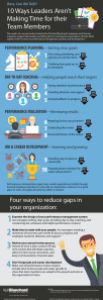
Work Conversations Infographic CoverPerformance planning, coaching, and review are the foundation of any well-designed performance management system, but the results of a recent study suggest that leaders are falling short in meeting the expectations of their direct reports.

Researchers from The Ken Blanchard Companies teamed up with Training magazine to poll 456 human resource and talent-management professionals. The purpose was to determine whether established best practices were being leveraged effectively.

Performance-Management-Gap-InfographicThe survey found gaps of 20-30 percent between what employees wanted from their leaders and what they were experiencing in four key areas: Performance Planning (setting clear goals), Day-to-Day Coaching (helping people reach their targets), Performance Evaluation (reviewing results), and Job and Career Development (learning and growing.)

Use these links to download a PDF or PNG version of a new infographic that shows the four key communication gaps broken down into ten specific conversations leaders should be having with their team members.

Are your leaders having the performance management conversations they should be? If you find similar gaps, address them for higher levels of employee work passion and performance.

You can read more about the survey (and see the Blanchard recommendations for closing communication gaps) by accessing the original article, 10 Performance Management Process Gaps, at the Training magazine website.

(This post was originally written and published by David Witt at LeaderChat.org.)