Leading with Trust

4 Ways to Measure a Politician’s Trustworthiness

trustA trustworthy politician…some might say, “Is there such a thing?” Listening to the rhetoric of this year’s presidential election would make one think neither of the two major party candidates has a trustworthy bone in their body. But trust isn’t an “all or nothing” proposition. Very few people are unequivocally trustworthy or untrustworthy in every aspect of their behavior. We all make mistakes and act in ways that erode other’s trust, but by and large, I think most people strive to be trustworthy the majority of the time.

The definitive way to judge someone’s trustworthiness is to observe their behavior over time. Does the person consistently act in ways that build trust with others or are they inconsistent and unpredictable in their behavioral patterns? When examining a person’s behavior to assess their trustworthiness, there are four factors to consider: Ability, Believability, Connectedness, and Dependability. I call these the ABCD’s of trust.

  1. Ability—Does the person demonstrate competence in their given role or function? Do they have the skills, expertise, and track record of success that gives you confidence in their abilities? We trust competent people because they have good planning, problem-solving, and decision-making skills. They know how to get the job done and how to do it right.
  2. Believability—A believable person acts with integrity. You can believe this person because he/she not only talks the talk, but walks the walk. A believable person is honest, credible, authentic, and owns up to their mistakes when they happen. Believable people are also fair in their dealings with others. They treat people equitably and ethically and don’t bend the rules by playing favorites.
  3. Connectedness—A connected person demonstrates trustworthiness by caring about people. They are kind, compassionate, and concerned with the well-being of others. They are also open communicators. They readily share information, are receptive to feedback, and listen well. Connected people build rapport with others and promote a sense of connection and harmony, not divisiveness and rancor.
  4. Dependability—A trustworthy person is dependable. They honor their commitments by being reliable. If they say they are going to do something, they do it. A dependable person builds trust by holding him/herself accountable, and if they lead others, holding their team members accountable as well. Dependable people are also responsive. They anticipate others’ needs and flexibly respond to the situation at hand.

I like to think of the ABCD’s as the language of trust. When a person’s behavior shows they are able, believable, connected, and dependable, they are communicating to me they are trustworthy. I know I can extend my trust to them with a reasonable expectation they won’t let me down.

As you head to the polls tomorrow to cast your vote in local, state, and national elections, consider the trustworthiness of the candidates by examining their ability, believability, connectedness, and dependability.

Halloween News Alert! 4 Warning Signs Your Boss is a Zombie

ZombieOrganizations around the world are reporting their leaders are turning into zombies at an alarming rate. Formerly healthy, productive, and capable leaders are falling victim to the Zombie Plague, a deadly disease that is spreading uncontrollably across the globe.

Leadership development experts recommend everyone be on alert for the symptoms listed below. If your boss demonstrates any of these behaviors, please consult a professional immediately.

1. They are running on autopilot — Zombie’s are empty vessels with no willpower or mind of their own. They wander about aimlessly with no clear purpose other than to satisfy their basic needs for survival (mainly terrorizing and eating humans!). Zombie leaders have become complacent and stopped investing in their own growth and learning. They do the minimum amount of work required to keep the ship afloat and they’ve stopped pushing the boundaries to innovate and adapt to new realities in the marketplace. If your boss is content with doing the same ‘ol, same ‘ol, she might be infected.

2. They are a doomsdayist — Healthy leaders are purveyors of hope and positive energy. They cast a compelling vision of the future that inspires their followers to commit to the goal, team, or organization. Zombie leaders tend to have a sense of doom and failure. They waste their energy focusing on all the reasons why something can’t be done rather than working to find new solutions. They’re often heard saying “Why change? That’s the way we’ve always done things around here.”

3. Their relationships are strained and difficult — Zombie leaders tend to have a low EQ (emotional quotient) that makes them ill-prepared to develop strong interpersonal relationships. They fail to build rapport with their followers, don’t collaborate well with colleagues, and have a low self-awareness about how they “show up” with other people. In fact, zombie leaders reading this right now probably fail to identify with any of these qualities and instead are muttering to themselves “I wish my boss was reading this article.”

4. They are in a “trust-deficit” — Leaders infected with the zombie virus are notorious for breaking trust with their followers. Failing to follow through on commitments, taking credit for other people’s work, not “walking the talk,” and withholding recognition and praise from others are all ways that zombies erode trust. The low-trust relationships that zombie leaders have with their followers results in reduced productivity, gossiping, questioning of decisions, and low levels of employee morale and engagement.

Various remedies are available to prevent leaders from contracting the Zombie Plague or to treat those already infected. The therapy plan extends over the course of a leader’s lifetime and requires constant diligence to ensure the disease stays in remission. Treatments include ongoing learning and self-improvement, building trust in relationships, and adopting a servant-leader philosophy.

10 Ways Leaders Aren’t Making Time for Their Team Members (Infographic)

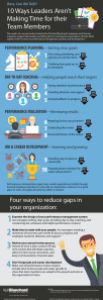
Work Conversations Infographic CoverPerformance planning, coaching, and review are the foundation of any well-designed performance management system, but the results of a recent study suggest that leaders are falling short in meeting the expectations of their direct reports.

Researchers from The Ken Blanchard Companies teamed up with Training magazine to poll 456 human resource and talent-management professionals. The purpose was to determine whether established best practices were being leveraged effectively.

Performance-Management-Gap-InfographicThe survey found gaps of 20-30 percent between what employees wanted from their leaders and what they were experiencing in four key areas: Performance Planning (setting clear goals), Day-to-Day Coaching (helping people reach their targets), Performance Evaluation (reviewing results), and Job and Career Development (learning and growing.)

Use these links to download a PDF or PNG version of a new infographic that shows the four key communication gaps broken down into ten specific conversations leaders should be having with their team members.

Are your leaders having the performance management conversations they should be? If you find similar gaps, address them for higher levels of employee work passion and performance.

You can read more about the survey (and see the Blanchard recommendations for closing communication gaps) by accessing the original article, 10 Performance Management Process Gaps, at the Training magazine website.

(This post was originally written and published by David Witt at LeaderChat.org.)

10 Ways Leaders Can Easily Build Trust with Their New Teams

Trust StonesThe new president of the company came in with grandiose visions of the future. She saw the untapped potential of the organization and set a vision for increasing revenues by ten fold. She preached her message of change with catchy slogans to create excitement and instituted sweeping changes by bringing in people outside the organization whom she trusted to lead key initiatives.

She was large and in charge, but she forgot the one critical thing that would determine her ultimate success. She forgot to build trust with her team, and it was that lack of trust that resulted in her ouster just a few years later.

Trust is the catalyst that spurs innovation, the bonding agent that holds everyone together, and the lubrication that keeps things working smoothly in an organization. But trust doesn’t “just happen” by accident. It takes intentional effort and leaders need to have a specific game plan to establish and nurture trust in relationships.

The primary goal of any leader stepping in to lead a new team should be to build trust. Here are 10 easy ways leaders can get started:

1. Refrain from making bold proclamations — You probably have big goals for your new team and that’s likely why you were hired for the job. That’s great! But before you start proclaiming your vision for the future, spend time developing relationships with your new team members. Some of them may not know you from Adam. Some may be excited about you joining the team and others may be fearful. Be humble, exercise patience, and establish trust with your team before making bold proclamations. If your team trusts you, they’ll be much more receptive to hearing and acting on your message.

2. Ask open-ended questions — Dial down the temptation to start barking orders or making evaluations about current practices and ask open-ended questions instead. Saying “Tell me more about why the process was designed that way” builds trust more than saying “That process doesn’t make sense. Why do you do it that way?” The former comes from an attitude of inquisitiveness and wanting to learn, whereas the latter comes from a position of evaluation and judgment. You’ll learn a lot more from your team by asking open-ended questions.

3. Ask other people for their ideas — Chances are you have some pretty smart team members who know the business quite well. They probably have excellent insight into how things could work better, where the gaps are, and what could be done to improve the business. So ask them. Don’t think you have to come up with all the answers yourself. People who plan the battle rarely battle the plan. Involve your team in developing plans and making decisions and trust will flourish.

4. Approach your role as a learner — You will develop trust much faster with your team if you approach this transition as a learner rather than acting like you’re a know-it-all. What attitudes do learner’s have? They are humble because they know they don’t know everything. They are open to new ideas, taking direction, and appreciative of others who are willing to share their expertise. Those are the same characteristics you should have when stepping in to lead a new team.

5. Go slow with changes — Practically every leader I’ve met has wanted to implement change quickly. And my experience has shown that effective change takes much longer to implement than we estimate or prefer it to take. So plan your schedule accordingly. Understand that your team is getting to know and trust you, and once that happens, they will be more receptive to the changes you want to implement. If you try to implement too much change before the team trusts you, they will resist and work against you rather than with you.

6. Respect the culture — Every organization and team has its own unique culture, and as the new person to the team, you need to be purposeful about learning the new culture and becoming part of it. A big no-no is to compare your new team or organization to your old one. When you keep bringing up your old company and make statements like “we did it this way” or “we should do it like my old team,” it makes your team question your loyalty. Using the pronoun “we” makes your team feel like a part of you is still with the old team. You’re not with your old team anymore so quit talking about them. When you need to reference your past experience, use the pronoun “I”—I’ve had experience doing it like this and it worked well—and it will go over better with your team.

7. Be nice — It sounds silly that this even has to be mentioned but you’d be surprised at how many leaders miss this obvious way to build trust. Just be nice. Say please and thank you. Smile at people. Ask them how they’re doing. Build rapport. It’s the little things that go a long way in building trust.

8. Catch people doing something right — When I do training sessions with clients I often ask the group this question: “How many people are sick and tired of their boss praising them at work?” No one ever raises their hand! The truth is people don’t get enough pats on the back for their achievements on the job. It doesn’t cost much—except time and effort—for leaders to praise team members, yet it’s one of the most powerful ways to build trust.

9. Laugh at yourself — Humor is a fantastic antidote to many of the ills of the day-to-day stress of organizational life. Well timed and appropriate humor keeps the mood light, lifts people’s spirits, and eases tension. Leaders who are not only humorous, but are vulnerable enough to laugh at themselves, have a leg up when it comes to building trust. People trust others whom they like and know. Humor breaks down barriers between people and allows us to get to know each other on a more personal level.

10. Extend trust — Someone has to make the first move when it comes to trust. Trust can’t be developed unless one party is willing to assume a little risk and extend trust to the other. I believe it’s the leader’s responsibility to go first in extending trust. Doing so sends a powerful signal to your team members and it creates a safer environment for them to reciprocate and extend trust to you.

I said earlier that these were “easy” ways to develop trust. Let me qualify that statement. Some of these ways are easier than others, and depending on your personality, some may be quite difficult for you. However, they are all eminently do-able. They just take intentional effort, and if you follow through and try some of these, you’ll find trust will start to blossom with your new team.

Feel free to leave a comment with other strategies or suggestions to build trust with a new team. I’d love to hear your thoughts!

Infographic: New Managers Aren’t Getting The Training They Need to Succeed

Infographic New Managers TrainingIn a recent survey conducted by The Ken Blanchard Companies, more than 400 managers were asked to rate different types of training by order of importance. Here’s their top ten, ranked in order from most important to least important type of training (see infographic.)

At the top, managers identified communication skills, help with transitioning to a leadership role, and interpersonal skills as the most needed training.

In the middle, they identified setting goals, directing others, and managing conflict as next most important.

In the last four slots, the respondents identified training on delegating tasks, dealing with performance issues, understanding HR policies, and conducting performance reviews as somewhat less important.

Scott Blanchard, a principal with The Ken Blanchard Companies and coauthor of the company’s new First-time Manager program prioritizes a similar list in the September issue of Ignite.

“A new generation of managers is moving forward. But we’ve found that first-time managers are not getting the training they need in key areas—including communication skills, transitioning to a new role as manager, and interpersonal skills. As a result, more than half of the people we surveyed said they were not prepared for their first manager role.”

Blanchard highlights results from the same survey showing that only 39 percent of new managers with fewer than 3 years on the job reported having received any leadership training. Just 34 percent had received any mentoring. And a mere 31 percent had received coaching.

According to Blanchard, if new managers are going to succeed, organizations need to be more consistent and proactive in their approach. Otherwise, managers are left to their own devices with mixed results. In fact, research from CEB indicates that as many as 60 percent of new managers underperform or fail within their first two years.

“With over two million millennials stepping into first time leadership roles each year in the US alone, we need to take steps immediately to better train new managers for their first roles,” says Blanchard.

To address this, Blanchard recommends that organizations focus their new manager training curriculum on two areas: communication skills and conducting work-related management conversations.

“We teach communication skills drawn from our Coaching Essentials program—including Listening, Inquiring, Telling Your Truth, and Expressing Confidence.  Then we take a deeper dive into four conversations we feel are foundational for new managers: Goal Setting, Praising, Redirecting, and Wrapping Up.

Blanchard’s goal is to increase the winning percentages of new managers one conversation at a time.

“Our work relationships are contained and maintained in our conversations. Every interaction you have with an employee moves that relationship in a positive or negative direction. We believe the quality of a relationship over time is a result of the net impact of all the different conversations that have occurred.”

You can read more about Blanchard’s approach to first-time manager development in the September issue of Ignite. Use these links to download a PDF or PNG version of the infographic.

Leading with Character – The Key to Servant Leadership

leading-jesus-wayThe following is a guest post by Mark Deterding, author of the newly released book “Leading Jesus’ Way: Become The Servant Leader God Created You To Be.

Ever wonder what makes a good leader great? The answer is character.

Character is what flows out of the heart. It is what defines us as a leader. People want to follow people they can look up to and trust. So to become an effective servant leader, we must get intentional about building character.

Personal character is the sum of all the qualities that define us as individuals and as leaders. Warren Bennis cited Harvard research that indicated as much as 85% of a leader’s performance depends on his or her character. My experience in 35 years in business tells me the same thing.

The personal character of leaders defines their depth and stability; it is what leaders are truly made of.

Recognizing Character

When you look at leaders, you see many things. You can tell easily if they are intelligent, whether they have good technical skills and how much they understand the business and the industry. What you don’t see, because it is below the surface in their heart, is their character. That’s what Dwight Moody meant when he said, “Character is what you are in the dark.”

Servant leaders are defined and recognizable by their character. Servant leaders know that people will follow them only if they are trusted and trust is only developed through virtuous character.

Servant Leadership Character Traits

Key aspects of a servant leader’s heart that will separate them from the pack include:

  • A desire to serve others, above and beyond oneself
  • A desire for never-ending development of one’s ability
  • A desire to achieve one’s very best
  • A willingness to always accept responsibility for one’s actions
  • A commitment to being humble and vulnerable
  • A desire to make a positive impact on society

Issues of the heart don’t change overnight. We must first get intentional about positively developing all the areas of our character to become better servant leaders.

On-Going Development

This is not a matter that is looked at only once. It is something we must check up on from time to time. This can be done by asking others (truth tellers) what they think. But don’t just stop with the feedback – work to implement changes so you can grow and have a greater impact as a servant leader.

We can also start improving in this area from where we are today by identifying someone whose character you greatly respect. Write down what that person says or does that you admire. This will help you frame up areas that you want to focus on to enhance your trust and build your personal character.

Make the Commitment

Remember, building character and trust is a process that takes time. Make the commitment to start where you are and pray for guidance and stamina through the journey. In time, you will be blessed for your efforts, so stay the course and allow God to work through you to make an impact in this world.

Mark

For the Lord sees not as man sees: man looks on the outward appearance, but the Lord looks on the heart. ~ 1 Samuel 16:7

The Most Successful Apologies Have These 8 Elements

sorryI’m pretty good at apologizing and I think it’s primarily because of two reasons:

  1. I’ve been married for over 28 years.
  2. I mess up a lot.

That means I get a lot of practice apologizing. I’ve logged way more than 10,000 hours perfecting my craft, so by Malcolm Gladwell’s measurement, I’m pretty much the world’s foremost expert on apologies. The fact my wife is a loving and forgiving woman doesn’t hurt, either.

More than 28 years experience has shown me there are eight essential elements of an effective apology:

1. Accept responsibility for your actions – If you screwed up, admit it. Don’t try to shirk your responsibility or shift the blame to someone else. Put your pride aside and own your behavior. This first step is crucial to restoring trust with the person you offended.

2. Pick the right time to apologize – It’s a cliché, but true – timing is everything. You can follow the other seven guidelines to a tee, but if you pick a bad time to deliver your apology, all of your hard work will be for naught. Depending on the severity of the issue, you may need to delay your apology to allow the offended person time to process his/her emotions. Once he/she is mentally and emotionally ready to hear your apology, make sure you have the necessary privacy for the conversation and the physical environment is conducive to the occasion.

3. Say ‘”I’m sorry,” not “I apologize” – What’s the difference? The word sorry expresses remorse and sorrow for the harm caused the offended person, whereas apologize connotes regret for your actions. There’s a big difference between the two. See #4 for the reason why this is important.

4. Be sincere and express empathy for how you hurt the other person – Along with saying I’m sorry, this step is critical for letting the offended person know you acknowledge, understand, and regret the hurt you caused. Make it short and simple: “I’m sorry I was late for our dinner date. I know you were looking forward to the evening, and being late disappointed you and made you feel unimportant. I feel horrible about hurting you that way.”

5. Don’t use conditional language – Get rid of the words if and but in your apologies. Saying “I’m sorry if…” is a half-ass, conditional apology that’s dependent on whether or not the person was offended. Don’t put it on the other person. Just man up and say “I’m sorry.” When you add the word but at the end of your apology (“I’m sorry, but…”) you’re starting down the road of excuses for your behavior. Don’t go there. See #6.

6. Don’t offer excuses or explanations – Keep your apology focused on what you did, how it made the other person feel, and what you’re going to do differently in the future. Don’t try to make an excuse for your behavior or rationalize why it happened. If there is a valid reason that explains your behavior, it will likely come out during the apology discussion. But let the other person go there first, not you.

7. Listen – This is perhaps the most important point of the eight and one that’s often overlooked. After you’ve made your apology, close your mouth and listen. Let the offended person share his/her feelings, vent, cry, yell, laugh, scream…whatever.  Acknowledge the person’s feelings (“I understand you’re upset”…”I see I disappointed you”…”I know it was hurtful”), but resist the urge to keep explaining yourself or apologizing over and over again. I’m not suggesting you become an emotional punching bag for someone who is inappropriately berating you; that’s not healthy for either party. But many times the awkwardness and discomfort of apologizing causes us to keep talking when we’d be better off listening.

8. Commit to not repeating the behavior – Ultimately, an apology is only as effective as your attempt to not repeat the behavior. No one is perfect and mistakes will be made, but a sincere and earnest apology includes a commitment to not repeating the behavior that caused harm in the first place. Depending on the severity of the offense, this may include implementing a plan or process such as counseling or accountability groups. For minor offenses it’s as simple as an intentional effort to not repeat the hurtful behavior.

So there you go. The Great 8 of giving effective apologies, honed from years of groveling…err…apologizing for my mistakes. What do you think? Are there other tips you would add? Feel free to leave a comment with your thoughts.

5 Common Leadership Behaviors That Crush The Spirits of Employees

crushedI admit it. Sometimes when I’m under the gun at work and feeling the pressure of all my responsibilities, I can get tunnel vision about accomplishing my own goals and forget how my behavior is influencing others. It’s not that I’m trying to be insensitive to people, I’m just not being mindful or intentional in my actions.

I don’t think I’m alone in this regard. It happens to every leader from time to time when we’re under stress and reacting in the moment. It’s in these occasions that we have a tendency to focus on the objectives of the task and minimize the people concerns. Who cares how people feel as long as the job gets done, right? Well, consistently behaving this way may help you check items off your to-do list, but it can come at the cost of crushing the spirits of your team members in the process. Here are five common spirit-crushing behaviors leaders should avoid:

Micromanaging – Control is the opposite of trust, and micromanaging sends the message to your team members that you don’t trust them to do their jobs. It’s common for leaders to exert control when under stress because they feel more secure being able to directly influence the outcome. However, micromanaging saps the initiative of your team to the point where they stop taking responsibility because they know you’re going to step in and take charge.

Demeaning Others – Leaders demean others through careless comments that degrade their dignity, status, or character. An example is when a leader says or does things that communicates people are “less than” they really are. Stereotypical examples are asking an administrative assistant to pick up your dry cleaning or get you a cup of coffee, tasks clearly outside their job description.

Ignoring Others’ Contributions – We all have an innate need to be appreciated and it doesn’t take much for leaders to acknowledge the efforts of team members. Many times all it takes is saying thank you. A pattern of not recognizing the good work of others will eventually turn team members against you. People will develop a mindset of doing the minimum amount of work acceptable because “they don’t appreciate me going above and beyond.”

Intimidating or Coercing Others – This behavior is a holdover from the days of Command and Control leadership, but unfortunately, too many leaders still rely on this tactic to get work accomplished. I think there are two main reasons why this is the case. First, some leaders truly don’t know any better. They believe their job as the “boss” is to tell other people what to do, how to do it, and when to do it. Secondly, it’s the path of least resistance. When leaders are stressed and short on time and patience, getting work done by intimidating or coercing others seems the most expedient thing to do. It may work for you once or twice, but intimidating others will not only crush their spirits, it will create enemies that actively work against you and not with you.

Playing favorites – One of the most influential factors that crush a person’s spirit is being treated unfairly. We are hardwired with a desire for justice, and when we feel we’re aren’t being treated justly, it causes a variety of emotions ranging from defensiveness and anger to cynicism and despair. Leaders can be fair by treating people equitably and ethically. Being equitable means people receive what they deserve based on the circumstances, and being ethical means the leaders behavior is alignment with the values of the organization and it’s policies and procedures.

I believe most leaders have positive intentions. There are very few leaders who wake up in the morning and say to themselves, “I can’t wait to crush the spirits of my employees today!” No, that doesn’t usually happen, but what does happen is we get so focused on our own agendas that we forget how we’re treating our team members. Being more mindful of how our leadership impacts others and avoiding these spirit-crushing behaviors will help foster an environment where our people feel safe, appreciated, and free to give their all.

Debunking 8 Common Myths About Trust

myth-v-truthWhen conducting training classes to teach people how to become more trustworthy and build trust in their relationships, I often have to address some common myths. There are commonly held beliefs about trust that aren’t quite as true as people believe.

Here are eight common myths about trust and my thoughts about the truth behind these misconceptions.

Myth #1: Trust takes a long time to build — You’ve probably heard this said before or maybe even said it yourself. Sorry to burst your bubble, but it’s not altogether true. Yes, there are instances where trust can take a long time to build, such as relationships that have infrequent interactions or where one or both of the parties are trust-averse and uncooperative with each other, but in many cases trust is established quickly. When you walk in a doctor’s office and see diplomas on the wall from Harvard Medical School and John’s Hopkins, you have an immediate sense of trust based on the doctor’s expertise. The same is true for many professions where the individual’s expertise engenders immediate trust. A person’s reputation for being trustworthy also carries great influence when starting new relationships. Trust can be built very quickly.

Myth #2: Trust is lost in a second — This is the companion to myth #1. In relationships where a strong bond of trust has been formed, a single instance of violating trust rarely destroys the whole relationship. In fact, a high-level of trust in a relationship leads to the parties assuming best intentions about each other, so when a breach of trust occurs, the offending party is often given the benefit of the doubt. Instead of losing trust in a second, trust is more frequently lost when it’s broken repeatedly over a period of time. One party keeps making withdrawals from the trust account of the other party until eventually they start bouncing checks.

Myth #3: Trust is fragile — Because people believe the previous myth about it only taking a second to break someone’s trust, they assume that trust must be fragile. Wrong. Trust, true trust that has stood the test of time, is extremely resilient. Consider the most trustworthy relationships you’ve seen or experienced in life. They are probably ones that have endured their fair share of trust-busters, and yet because of the high level of trust between the parties, they addressed the challenging situations and moved beyond them in ways that continued to sustain and reinforce the trust between them.

Myth #4: Trust is soft — One of the most common myths I encounter, particularly from senior leaders, is that trust is a “soft” interpersonal issue. You know what I mean, the group hug, hold hands, and sing kumbaya kind of soft. Well, trust is anything but soft. Trust has hard, bottom-line impacts to people and organizations. Research has shown that high trust companies consistently outperform low trust ones. High levels of trust enables innovation, creativity, productivity, collaboration, and lower turnover, all of which directly impact an organization’s bottom-line.

Myth #5: Trust “just happens” — People assume trust just happens naturally, like some sort of relationship osmosis. The truth is trust is built through the use of very specific behaviors that can be taught, learned, and practiced. If you’re leaving the building of trust to chance, well, chances are you’re not going to be successful. Learn the specific elements of trust and how you can use their associated behaviors to become more trustworthy and develop high-trust relationships.

Myth #6: Distrust is the opposite of trust — On the surface this seems to make sense, right? If we have a spectrum with trust on one side, then distrust must be on the other. Actually, the opposite of trust is control. Control? Yes, control. See, when you don’t trust someone you try to maintain control. Staying in control means less risk, and risk is required when trusting someone. Without risk there is no need for trust and trust requires that you give up control to one degree or another.

Myth #7: Trust is all about integrity — Integrity is one of the four core elements of trust and most people identify it as being the most important when it comes to building trust. However, integrity is just one of the building blocks of trust. Another is competence. People who have expertise, a proven track record, and are effective at what they do inspire trust. A third element of trust is connectedness, showing care and concern for others by building rapport, communicating effectively, and demonstrating benevolence. Finally, the fourth element of trust is dependability. You build trust when you are reliable, accountable, and responsive in your actions.

Myth #8: Trust is all or nothing; you either have it or you don’t — Trust is not a one size fits all proposition. There can be different levels of trust in relationships based on the nature of the relationship and context of the situation. For example, you may have a high level of trust in your plumber to fix plumbing issues in your house, but you wouldn’t trust him to repair your automobile because it’s not his area of expertise. Or, you may have someone in whom you confide your deepest feelings to because they have earned your trust as a close confidant, but their history of being habitually late causes you to not trust them to arrive on time for an appointment.

Many times we accept myths as truths because on the surface they seem pretty reasonable. That’s the case with these myths about trust. But when you dig a little deeper, you begin to see that trust is not quite as simple as we make it out to be. It’s actually quite complex and multi-dimensional.

I’m interested in your experience. What are other myths about trust you’ve encountered? Please take the time to share by leaving a comment.

The 4 Unmet Needs That Lead to Disengaged Employees

4 Basic Human Needs for Engagement

Thanks to Tanmay Vora at QAspire.com for the sketchnote

Everyday the spirits of millions of people die at the front door of their workplace. There is an epidemic of workers who are uninterested and disengaged from the work they do, and the cost to the U.S. economy has been pegged at over $300 billion annually. According to a recent survey from Deloitte, only 20% of people say they are truly passionate about their work, and Gallup surveys show the vast majority of workers are disengaged, with an estimated 23 million “actively disengaged.”

This issue presents a tremendous challenge for organizational leaders. Even worse than dealing with the effects of people who leave your organization (studies show replacing employees can be 1.5 to 3 times their annual salary), you have to manage these disengaged workers who have decided to “quit and stay.” You’re still paying them to under-perform and ultimately undermine the effectiveness of your organization!

In conducting over 19,000 exit interviews of employees who voluntarily left their jobs, Leigh Branham, author of The 7 Hidden Reasons Employees Leave, identified four basic needs that weren’t being met that started people on the path to disengagement and ultimately quitting a job.

The Need for Trust — The number one priority for any leader is to build trust with his/her team members. Trust is the foundation of any successful relationship, and in the workplace it’s a non-negotiable if leaders desire to tap into the full effort and passion of their employees. Employees won’t give you their best if they don’t believe you have their best interests in mind. They will shy away from taking risks or making themselves vulnerable if they don’t feel safe and trusted. They expect company leadership to deliver on their promises, to be honest and open in communication, to invest in them, and to treat them fairly. The ABCD Trust Model is a helpful tool for leaders to understand what it means to be trustworthy and build trust with others.

The Need to Have Hope — I’ve had the privilege of meeting football legend Rosey Grier, a member of the “Fearsome Foursome” when he played with the Los Angeles Rams, and now a Christian minister and inspirational speaker. He said something I’ve never forgotten. When speaking about his work with inner city youth in Los Angeles, Rosey said “Leaders aren’t dealers of dope, they are dealers of hope!” So true…leaders are dealers of hope. We need to instill a sense of hope in the people we lead. Our people need to believe they will be able to grow, develop their skills, and have the opportunity for advancement or career progress. It’s our job as leaders to foster that hope and support our employees in their growth.

The Need to Feel a Sense of Worth — Despite its struggles and challenges, work is an intrinsically rewarding experience for people. We derive a tremendous amount of self-worth from our work, whether it’s something we’re employed to do or whether we volunteer our time and effort. Employees have a need to feel confident that if they work hard, do their best, and demonstrate commitment and make meaningful contributions, they will be recognized and rewarded appropriately.

The Need to Feel Competent — Employees need to be matched in jobs where their talents align with the challenges of the work. If the work is too simple, then it’s easy for people to lose interest and become disengaged. If the employee is in over his/her head and the work is too challenging, it can lead to discouragement and frustration. Leaders are on a constant quest to find ways to place employees in that sweet spot where they are challenged at just the right level. But it’s not all on the shoulders of leaders to do this work. Employees need to take responsibility for their own development and learn how to manage their motivational outlooks.

Employee engagement is a broad and complex topic, so much so that most leaders feel overwhelmed at how to make a meaningful impact. Focusing on ways to meet these four critical needs will lay the foundation for an environment where your employees develop and thrive in their roles.

4 Ways to Develop & Retain Employees When You Can’t Give Promotions

Climbing the corporate ladder has long been the traditional view of success in an organization. The main strategy for developing and retaining key talent has been to keep them engaged through a series of promotions and title changes that satisfy an individual’s need for growth and recognition.

Corporate Ladder vs Lattice

Credit: The Corporate Lattice, Deloitte University Press

Well, in most organizations these days, the corporate ladder has been replaced by the corporate lattice. The flat design of most organizations has eliminated the ladder—multiple layers of structure—and instead created an environment where growth has to be achieved in a zig-zag, network pattern of project-based assignments or leadership experiences. So when leaders don’t have the ability to hand out promotions, how do they grow, engage, and retain their key talent? Here are four approaches:

1. Ask your team members what they’re interested in doing — Asking someone what they want…novel concept, huh? Many leaders choose not to have this conversation because they are afraid they won’t be able to provide what is requested. Instead, frame the conversation with your employees as a time to explore opportunities with no strings attached. I tell team members that nothing is off the table when we have these conversations and I balance it with also saying I’m not making any promises. We’re simply exploring options, yet I make it clear that I’m in the employee’s corner and will do everything in my power to help them achieve their goals if there is a way we can find alignment between their interests and the needs of the organization.

2.Don’t be constrained by job descriptions — My HR colleagues may cringe a bit with my philosophy, but I believe leaders need to think beyond job descriptions when it comes to employee growth. Too often we get locked into job descriptions as the defining scope of a person’s responsibilities, including who reports to who in the chain of command. In reality, we need to consider the job description as the broad outline of how and where the person will contribute to the organization. Growing in the corporate lattice requires people to take on BHAG’s (Big, Hairy, Audacious Goals) that allow them to develop new skill-sets and competencies. Leaders should frame growth as an individual’s chance for resume enhancement that will benefit them in the future, whether at your organization or somewhere else.

3. Give away parts of your job — Most leaders have far too much on their plates to accomplish on their own, so why not delegate some of your key responsibility areas to competent and motivated team members? It’s hard for some leaders to go this route because it means giving up control and trusting others. It can also be threatening to your ego, as if it’s an admission you aren’t capable of doing it all on your own. Actually, smart leaders use this strategy because it’s a win-win for everyone. Your employees get to take on challenging goals and they earn the satisfaction of contributing in important ways, and you deliver on the key objectives for your team and develop a strong bench of capable and committed team members.

4. Adopt a mindset of being a developer and exporter of talent — Leaders should consider it a fiduciary responsibility to help their people grow, even at the risk of having them leave for greener pastures at some point in the future. My experience has shown when employees clearly know you are on their side and will do whatever you can to support their growth, they devote even more loyalty to you and will stay with you as long as possible. Who would want to leave an environment where they know their boss bends over backwards to provide opportunities for growth and development? Not many.

The corporate ladder doesn’t exist in many organizations these days and leaders don’t have the ability to hand out promotions like they were candy. We’ve got to have ongoing career conversations with team members, look for areas of growth beyond the boundaries of job descriptions, delegate key responsibilities to others, and be willing to invest in developing people, even at the risk of them ultimately leaving the organization. Using these strategies to navigate the corporate lattice, combined with financial models that facilitate income growth, will help you develop an engaged and passionate workforce that fuels personal and organizational success.

3 Ways to Create Trust with Millennials in the Workplace Today

The following is a guest post by Dan Negroni, author of the newly released book Chasing Relevance: 6 Steps to Understand, Engage, and Maximize Next Generation Leaders in the Workplace.

Chasing RelevanceMillennials will be 75% of your workforce in the next 10 years. As a manager or leader, this might make you nervous. Millennials live and work much differently than you do. Handing over the reigns to Generation Y and establishing their trust will take real deal, no BS effort on your part. However, this is necessary. We must build trust with millennials if we want to bridge the generational gap and work effectively today. Here are 3 ways you can create trust with your millennial employees starting now.

Show that you care

As the saying goes, people don’t care about how much you know until they know how much you care. In order to establish trust, caring by itself isn’t enough—you must show that you care. You may genuinely care, but if you don’t show and express that you do, it does no good. They need to believe you are authentic and real. Ask your millennials questions to really understand them and build trust.  Questions like “How can I help you in any way?” and “What do you need from me to learn, grow and provide value?” are great, as long as you are being authentic. Make an effort to show up for them in this honest and direct way through all coaching opportunities daily. You can start by simply explaining how grateful you are to them for leaning in. Showing gratitude, even if it’s for something small, goes a long way…it shows that you care! And caring is critical for building trust… and it takes repeatable and consistent behavior, just like all of your relationships.

Check in regularly

A poll by Gallup revealed that only 19% of millennials routinely receive feedback and only 15% of millennials routinely ask for feedback.[i] This discrepancy offers you an incredible opportunity to build trust. Make yourself approachable so your millennials feel comfortable to want to ask you anything. Whether it’s physically coming in the office, sending regular texts or another form of communication, establish a relationship with your millennials on a regular, weekly basis. Act in a way that’s relevant to them, which lets them know you care. They will remain loyal and retention will go through the roof.

You need to lead the way and initiate a feedback loop by engaging with them and effectively communicating that they can and should come to you with questions, ideas and feedback. This results in how to connect and trust better.

Own your stuff and be responsible

As a manager or leader, you must be accountable for your actions—and show it. In order to establish respect and trust with millennials, be transparent. Own up to your mistakes. Take responsibility when you mess up. By doing so, you not only set a positive example for your millennial employees to follow, but you show authenticity and vulnerability. Vulnerability is key to connecting with millennials because it makes you more real and humanizes you. They will feel more comfortable approaching you and trusting you.  So own up and be transparent about your wins and losses!

Show that you care. Make yourself open and approachable. Check in regularly and engage with your millennial employees daily. Be authentic, be vulnerable and take responsibility for your actions. Start developing trust with your millennials today!

[i] Adkins, Amy, and Brandon J. Rigoni. “Managers: Millennials Want Feedback, but Won’t Ask for It.” Gallup. Gallup, Inc., n.d. Web.